

What if your Google Ads aren’t the problem, but the page your clicks land on? In Hong Kong’s competitive market, every visit that fails to convert can push up acquisition costs. A polished website may impress, yet still leave prospects unsure what to do next. Effective landing page design services Hong Kong businesses invest in need to do more than look sharp: they should help visitors understand the offer and take the next step.
Paid traffic needs to generate measurable returns. The missing piece is often a deliberate conversion journey that matches the ad promise, addresses buyer concerns and makes action straightforward. A landing page isn’t just a page. It’s a focused experience that can guide attention towards a qualified enquiry or purchase.
This guide explains how page structure, a relevant offer and conversion rate optimization can strengthen lead generation without relying on higher ad spend alone. You’ll learn how to connect landing pages with Google and Facebook advertising, reduce friction in the customer journey and assess performance by its impact on enquiries and sales opportunities, not by design jargon.
Key Takeaways
- Identify where a broad corporate homepage creates friction, then give each campaign a focused page and a clear next step.
- Use a clear message, relevant proof and a compelling offer to help prospects understand your value and act with confidence.
- Assess landing page design services Hong Kong businesses consider by how well strategy, mobile usability and campaign tracking support measurable outcomes.
- Build a stronger page by profiling your audience, mapping their concerns and shaping headlines around the problems they want to solve.
- See how Populis Digital connects web design, Google and Facebook advertising, marketing funnels and CRO in a more systematic growth strategy.
Why Your Standard Corporate Website is Bleeding Money
A corporate website serves many audiences and goals. That can make it a poor destination for someone who clicked a specific Google or Facebook ad and expects a direct answer. In Hong Kong’s crowded digital market, paid traffic is too valuable to send into a maze of menus, company history and competing calls to action.
A landing page has a narrower job. A landing page is a standalone destination designed around a particular campaign goal. If an ad promotes a consultation, product or solution, the page should carry that message forward and make the next step unmistakable.
The Traffic-Conversion Gap in the HK Market
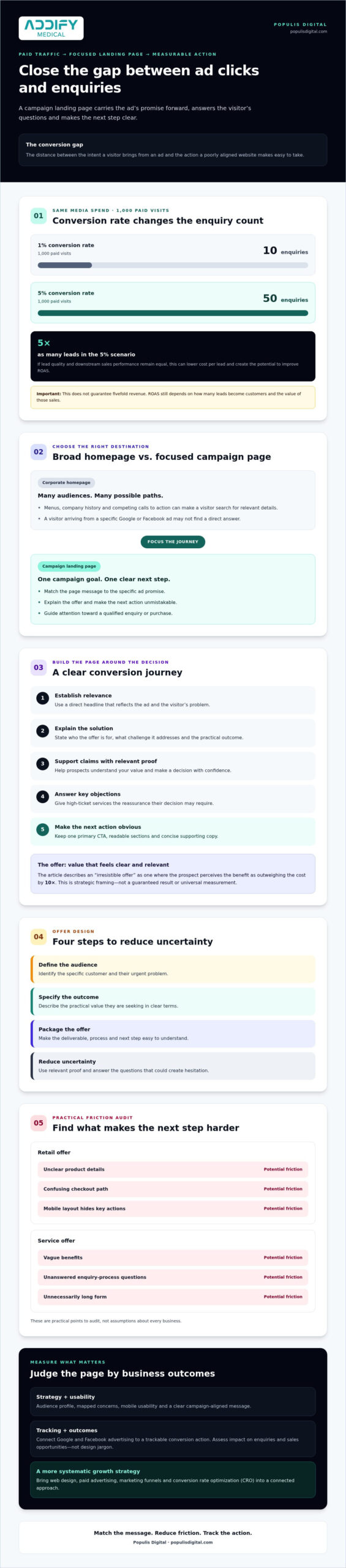
The conversion gap is the distance between the intent a visitor brings from an ad and the action a poorly aligned website makes easy to take. A prospect searching for a specific service may arrive ready to compare options, but a multipurpose homepage asks them to interpret broad claims, find relevant details and decide what to do next. Each extra choice gives them another reason to leave.
Consider 1,000 paid visits at the same media spend. A 1% conversion rate produces 10 enquiries; a 5% rate produces 50. If lead quality and downstream sales performance remain equal, the second scenario delivers five times as many leads for that traffic, lowering cost per lead and creating the potential to improve ROAS. It does not guarantee fivefold revenue: ROAS still depends on how many leads become customers and the value of those sales.
That’s the leaky bucket: you pay to bring people in, but the page loses them before they enquire. Strong landing page design services Hong Kong businesses evaluate should connect campaign intent to a focused page, a clear offer and a trackable conversion action. Design should support that journey, not serve as decoration.
Why “About Us” Doesn’t Sell, but “Solutions” Do
Trust matters, but a long company introduction rarely answers a visitor’s first question: “Can you solve my problem?” Shift the message from business-centred claims to customer outcomes. Explain who the offer is for, what challenge it addresses and what action to take. Give the page one primary goal, keep supporting proof relevant and remove navigation or secondary prompts that compete with the main action.
Friction varies by offer. A Hong Kong retailer may lose a ready-to-buy visitor through unclear product details, a confusing checkout path or a mobile layout that makes key actions hard to find. A service business may create hesitation with vague benefits, unanswered questions about the enquiry process or an unnecessarily long form. These are practical points to audit, not assumptions about every business.
Replace the passive digital brochure with a page that aligns message, offer and action, then gives your Google or Facebook campaign a focused destination. The goal isn’t to add more information. It’s to reduce friction between the prospect’s need and the next meaningful step.
The Psychology of High-Performance Landing Page Design
A landing page is easier to act on when its choices feel clear, relevant and credible. Colour and typography can support that experience, but aesthetics alone won’t resolve a mismatch between an ad and its destination or overcome uncertainty about the offer. Apply the psychological principles of design through message matching, focus and evidence: repeat the ad’s promise, show how the offer addresses a real problem, then make the next action obvious.
Cognitive ease is the feeling that a decision is simple to understand. Use a direct headline, concise supporting copy, readable sections and one primary CTA. A high-ticket service may require more reassurance than a quick purchase. Structure the page around that decision: establish relevance, explain the solution, support claims with proof, answer key objections, then invite the enquiry.
Triggering the “Irresistible Offer” Response
An irresistible offer is a value proposition where the prospect perceives the benefit as outweighing the cost by 10x. Treat that as a strategic framing, not a guaranteed result or universal measurement. For Hong Kong SMEs, build the offer in four steps:
- Define the audience: Identify the specific customer and their urgent problem.
- Specify the outcome: Describe the practical value they’re seeking in clear terms.
- Package the offer: Make the deliverable, process and next step easy to understand.
- Reduce uncertainty: Use relevant proof and answer likely objections before the CTA.
Reducing perceived risk doesn’t require an unsupported guarantee. Clarify what’s included, set realistic expectations and explain what happens after an enquiry. If a business chooses to offer a guarantee, its terms must be genuine, clearly stated and approved by the business.
Data-Driven Layouts: Visual Hierarchy and F-Patterns
Design the eye path rather than decorating around it. Visitors often scan instead of reading every line, so lead with the most relevant message, break supporting information into descriptive sections and make the CTA easy to spot. An F-shaped scan is a useful layout consideration, not a fixed rule for every person or device. On mobile, check that headings, proof and actions remain clear as visitors scroll.
The “above the fold” area sets context, but it doesn’t have to contain every argument. A strong headline and clear next step can encourage visitors to keep reading. Deeper sections can build trust with case evidence, benefits and answers to objections. Place social proof near the claims it supports, rather than leaving it only in a footer. For example, Populis Digital has served Henderson Land Group, a relevant credibility signal when presented in context.
Apply conversion rate optimization HK principles by testing one meaningful element at a time and measuring enquiry actions, not visual preference alone. Businesses assessing landing page design services Hong Kong can look for this combination of psychology, page structure and CRO. To explore how Populis approaches marketing funnels and conversion strategy, visit Populis Digital’s growth approach.
Strategic Comparison: Landing Pages vs. Traditional Web Design
A landing page isn’t simply a shorter website. The key difference is visitor intent. Someone arriving through organic search may be exploring a topic or comparing providers, so a full website’s navigation can help. Someone clicking a specific Google or Facebook ad has already responded to a particular promise. The destination should continue that message and guide them towards one relevant action.
Performance depends on alignment, not page length. A real estate campaign promoting a specific development, for example, needs a destination focused on that offer, not a homepage asking visitors to choose between unrelated services. A healthcare ad should likewise lead to information relevant to the advertised service, with a clear route to enquire.
Single-Purpose vs. Multi-Purpose Architectures
Broad navigation can become a “Navigation Death Trap” when it pulls paid visitors away from the campaign goal. A focused page reduces competing paths while retaining the details prospects need to make an informed decision. Tailor the message to the traffic source: Google Ads visitors may arrive with a specific search need, while Facebook and Instagram visitors may need more context before they act. In both cases, match the ad’s promise and make the next step clear.
For instance, a Hong Kong healthcare provider could direct campaign traffic to a dedicated service page with relevant benefits, proof and an enquiry option. Use this as a test scenario, not as evidence of a particular campaign result. The right structure depends on the service, audience and offer.
Performance, Measurement and ROI
There’s no universal conversion rate that defines “good” for Hong Kong real estate or education. Results depend on the offer, audience, traffic source, lead qualification and follow-up. Claims that landing pages outperform homepages by 200% shouldn’t be treated as a dependable benchmark without a named, relevant source. Compare your own campaign data instead, using consistent tracking and a clear conversion definition.
Start with practical technical checks: test load performance on mobile and desktop, confirm that key content and forms display and work on smaller screens, and verify that analytics records the intended enquiry or purchase action. Then compare cost per lead and lead quality across the landing page and existing destination. If the dedicated page converts more qualified prospects at the same media spend, it can improve campaign efficiency. It can’t guarantee lower CPL or positive ROAS.
The cost-benefit question is about lead value over time, not page design in isolation. Consider the effort to create and maintain a focused page alongside the potential value of qualified enquiries and the campaign data it produces. Businesses assessing landing page design services Hong Kong should look for a strategy that connects page architecture with advertising and conversion rate optimization, then measures outcomes. For broader scaling ideas, explore this guide to SME marketing agency strategies.
Landing Page Design Services Hong Kong: A Practical Framework
High-performing pages aren’t built from a universal template. They’re planned around a specific audience, offer and campaign, then refined with performance data. Use this five-step framework to turn local insight into a clearer path from click to qualified enquiry.
- Profile the audience: Define who you want to reach, what they’re trying to solve and what might stop them from enquiring. A property investor and a first-time homebuyer may need different messages, even if they’re considering the same service.
- Mine the message: Gather the questions prospects ask, the outcomes they value and the objections they raise. Shape the headline around the prospect’s problem and desired result, not a broad claim about the business.
- Engineer for mobile: Prioritize readable text, easy access to key details, thumb-friendly buttons and forms that are straightforward to complete on a small screen.
- Build local trust: Use relevant, verifiable testimonials, case evidence, service details and contact options. WhatsApp may suit an audience that prefers messaging, but offer it only if the business can manage enquiries through that channel.
- Test and iterate: Change one meaningful element at a time, such as the headline or CTA, and compare conversion actions and lead quality. Keep changes that improve the outcome, not simply the look.
Mobile-First Optimization for the HK Consumer
Responsive design is the baseline, not the finish line. Check the page on an actual phone: can visitors read the offer without zooming, tap the main CTA comfortably and complete the form without unnecessary effort? Mobile is a major part of Hong Kong’s web traffic, but the claim that 85% of local lead generation happens on mobile isn’t supported by the information available here. Measure your own device-level conversion data before setting a target.
For suitable campaigns, a WhatsApp conversation can provide a direct alternative to a form. Set expectations clearly, including what information to share and what the next step will be. Keep the page’s main goal visible, so offering a messaging option doesn’t create competing paths.
Integrating Automated Lead Generation Systems
A conversion shouldn’t end at form submission. Connect the page to a lead management process that organizes enquiries, captures useful qualifying details and helps distinguish high-intent prospects from early-stage interest. Keep questions relevant and proportionate; too much friction can deter good leads. A clear handoff then bridges the click to the sales conversation.
For service businesses pursuing high-ticket enquiries, landing page design services Hong Kong should connect audience research, mobile usability and funnel strategy, not stop at page delivery. Explore Populis Digital’s marketing funnel and CRO approach to plan a more measurable journey from campaign click to qualified lead.
Populis Digital: Your Growth Architect for Rapid Scaling
A landing page shouldn’t operate as an isolated design asset. It needs to connect the campaign promise to a relevant offer, a clear conversion action and a follow-up journey that helps turn enquiries into sales opportunities. Populis Digital approaches this as a growth architecture challenge: align the page with the marketing funnel, then use performance data and conversion rate optimization to identify where the journey can improve.
That’s the difference between delivering a visual layout and building a system designed to support growth. A page may attract attention, but if its message doesn’t match the ad or its enquiry process creates friction, the funnel breaks. Populis offers web design, marketing funnel creation, Google Ads Management, Facebook & Instagram Ads Management and CRO. These services can be brought together to support a connected campaign journey. Explore how landing pages fit into a complete marketing funnel.
Our Data-Driven Funnel Development Process
Effective funnel development starts with the audience and the decision they need to make. Map prospect needs and objections, shape an offer around meaningful value, and structure the page to guide visitors towards one relevant next step. Then assess performance using campaign and conversion data. If visitors click but don’t enquire, investigate message alignment, page friction and the offer before changing design elements at random.
Optimization doesn’t stop at launch. Review a landing page as campaign data accumulates and business priorities change. The Growth Architect approach connects strategy, page experience and advertising rather than leaving the business to coordinate disconnected pieces alone. Populis has served Henderson Land Group and specializes in high-ticket lead generation for service-based businesses.
From Clicks to High-Ticket Clients
For healthcare, real estate and other service businesses, the job is to turn a relevant click into a qualified enquiry, not simply increase page views. Google Ads can capture people actively searching for a solution; Facebook and Instagram Ads can introduce an offer to audiences earlier in their decision process. A landing page should reflect that intent, while the funnel gives each enquiry a clear next step.
Populis Digital uses psychology-based marketing funnels and compelling offers to support clients’ sales growth. Treat growth as an objective to measure, not a promised outcome. With landing page design services Hong Kong connected to ads management, marketing funnel creation and CRO, businesses can build a more coherent route from campaign click to sales conversation.
Ready to move from disconnected campaigns to a more deliberate growth system? Explore Populis Digital’s growth services and consider how landing pages, advertising and funnel strategy can work together for your business.
Turn Your Next Campaign into a Smarter Growth Engine
Your next step isn’t simply to make a page look better. Connect the right offer with the right audience, remove friction from the decision and measure whether enquiries become valuable opportunities. That’s how a landing page becomes a working part of your growth system.
Effective landing page design services Hong Kong businesses choose should align page strategy with advertising and ongoing conversion improvement. Keep the campaign promise consistent, make the next action clear and use performance data to guide what you refine. The goal isn’t clicks alone. It’s a stronger journey from prospect interest to qualified conversation.
Populis Digital brings a psychology-based growth architecture approach and specializes in high-ticket lead generation. The team has served Henderson Land Group. Use your own campaign results to determine what works for your business.
Ready to build a more focused lead-generation system? Explore Populis Digital’s web design, advertising and funnel services and plan a measurable route from campaign click to meaningful growth.
Frequently Asked Questions
What is the difference between a landing page and a website?
A website serves several purposes, while a landing page focuses on one campaign or conversion goal. A website helps visitors explore a business, its services and other information through navigation. A landing page gives a specific audience a focused message and a clear next step, such as making an enquiry. Match the page to visitor intent: broad discovery suits a website, while a specific ad response often benefits from a dedicated destination.
How much do landing page design services in Hong Kong typically cost?
The cost depends on what the project needs, so there isn’t one suitable price for every Hong Kong business. Scope can vary with page complexity, campaign strategy, copywriting, language requirements, technical features and whether the page forms part of a wider marketing funnel. When comparing proposals for landing page design services Hong Kong, check what’s included, how success will be measured and whether ongoing optimization is part of the scope.
How long does it take to see results from a new landing page?
There’s no fixed timeframe for results because performance depends on traffic volume and quality, campaign spend, the offer, conversion tracking and the time prospects need to decide. Once the page is live and tracking works, monitor visits, enquiries and lead quality. Treat early data as a signal, not a verdict. Allow enough relevant traffic to assess performance, then test specific improvements rather than expecting an instant lift.
Do I need a landing page if I already have a high-traffic website?
Possibly. High traffic alone doesn’t show whether visitors arrive with the right intent or take a valuable action. Keep your main website for discovery and broader browsing, then use focused landing pages for campaigns with distinct audiences, offers or calls to action. For example, a Google Ads campaign for one healthcare service can lead to a page about that service instead of a general homepage, making message relevance and campaign results easier to assess.
Can a landing page be integrated with my existing CRM and email tools?
Often, yes, if the page platform and your CRM or email tools support a compatible connection. Integration options may include built-in connectors, an API or an approved automation service, but the exact setup depends on your systems. Before launch, confirm which fields should transfer, how enquiries are labelled and who follows up. Ask the provider to verify compatibility with your specific platforms rather than assuming every tool connects automatically.
What makes a landing page “high-converting” in the Hong Kong market?
A high-converting page aligns its message with the campaign, presents a compelling and understandable offer, reduces friction and makes the next step clear. For Hong Kong audiences, consider whether English, Traditional Chinese or both suit the target market, and ensure the page works smoothly on mobile. Add credible local proof where available, answer likely questions and offer a suitable contact path, such as a form or WhatsApp, if your business can manage it.
Should I use a template or a custom-designed landing page?
Choose based on campaign needs, not on the assumption that custom is always better. A template can suit a straightforward offer if it supports your brand, mobile usability and tracking requirements. A custom design may be more appropriate when the campaign needs a distinctive message, complex content or a specific user journey. In either case, review the page against the same criteria: ad-message match, clarity, usability and measurable conversion actions.
How do landing pages improve my Google Ads Quality Score?
A landing page can support a stronger Google Ads experience when it closely matches the ad and keyword, offers useful content and is easy to use. Google’s Quality Score diagnostics include expected click-through rate, ad relevance and landing page experience. A dedicated page can improve message alignment, but it doesn’t guarantee a higher score. Review Google Ads’ diagnostics alongside page performance, and keep the ad promise, headline and conversion action consistent.