

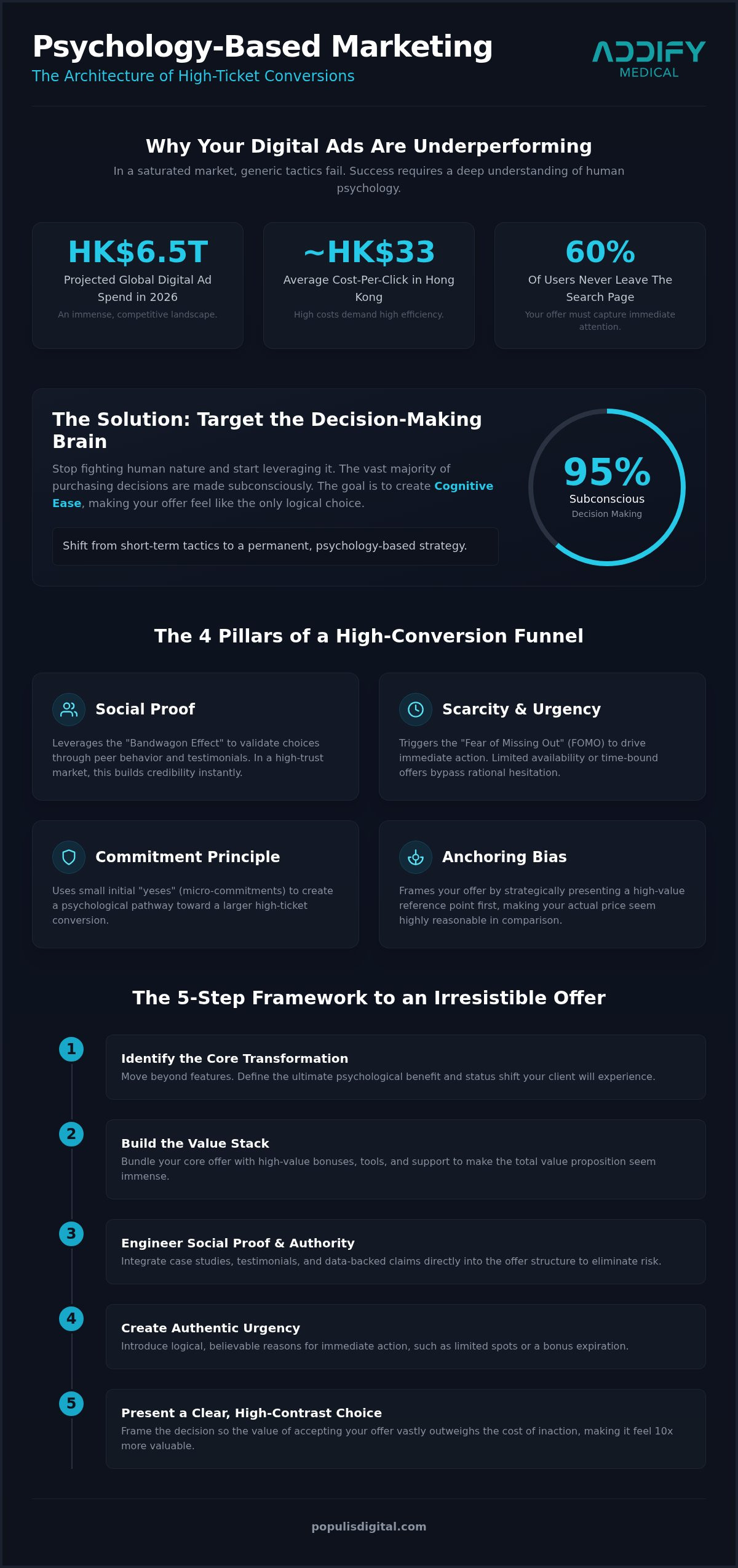
Your technical ad settings aren’t failing you. Your understanding of the human brain is. With global digital ad spend projected to hit HK$6.5 trillion in 2026, the battle for attention has moved from the algorithm dashboard to the human subconscious. Most HK businesses are burning cash on an average CPC of approximately HK$33 only to be ignored. They’re stuck with generic offers that fail to trigger immediate action. This isn’t just a marketing problem; it’s a structural failure in psychological engineering.
You’ve likely felt the frustration of watching high-performance budgets deliver low-performance results. It’s a stagnation trap that many firms in the competitive Hong Kong market can’t escape. Implementing a psychology based marketing strategy is no longer an optional upgrade. It’s the only way to bypass the “zero-click” trend where 60% of users never leave the search page. We’ll show you how to master the cognitive frameworks required to transform passive browsers into high-ticket clients.
This blueprint provides a repeatable framework for creating irresistible offers that command attention. You’ll learn to engineer higher ROAS through messaging that feels like a natural solution rather than a forced sales pitch. It’s time to stop being a mere service provider and start being a growth architect who dominates the digital landscape with precision and data-backed authority.
Key Takeaways
- Shift from short-term digital tactics to a comprehensive psychology based marketing strategy that builds a permanent competitive advantage in the high-stakes HK market.
- Leverage the science of System 1 thinking to influence the 95% of consumer decisions made subconsciously before the rational mind can intervene.
- Engineer high-authority social proof and authentic urgency to transform passive observers into committed high-ticket leads without sacrificing brand integrity.
- Apply the 5-step “Irresistible Offer” framework to build a value stack that makes your services feel 10x more valuable than the price point.
- Integrate automated, psychologically-optimized funnels to scale your lead generation and eliminate the friction of manual, low-conversion sales processes.
What is a Psychology Based Marketing Strategy?
A psychology based marketing strategy is the rigorous application of cognitive science to digital sales funnels. It’s the difference between guessing and engineering. Most HK SMEs rely on “tactics,” which are short-term tricks like flash sales or clickbait headers. These might provide a temporary spike, but they don’t build long-term equity. True strategy is growth architecture. It utilizes Psychographic segmentation to understand exactly how your audience processes information, feels pain, and seeks status. The ultimate goal is Cognitive Ease. This is the mental state where information is processed without friction, making your offer feel like the only logical choice for a busy professional in Central or a tech-savvy consumer in Tsim Sha Tsui.
In a city as digitally saturated as Hong Kong, your brand is competing with thousands of messages every hour. Generic ads are invisible. You need to speak directly to the brain’s primitive decision-making centers to win. We don’t just “run ads.” We design psychological environments that guide a prospect from curiosity to conversion with mathematical precision. If your marketing feels like a struggle, it’s because you’re fighting against human nature instead of leveraging it.
The Shift from Features to Psychological Benefits
Customers don’t buy products. They buy transformations. A high-ticket client in the HK real estate or healthcare sector isn’t looking for a “service.” They’re looking for the status of a market leader or the safety of a proven outcome. To identify the hidden driver, you have to look past rational logic. While a customer might say they want a lower price, they’re often seeking the psychological comfort of a “premium” choice that minimizes their perceived risk. In a high-pressure market, emotional decision-making happens in milliseconds. Your funnel must address these subconscious cravings before the rational mind can find an excuse to click away. We focus on the “why” behind the click, ensuring every headline triggers a specific emotional response.
The Role of Data in Validating Psychological Hypotheses
We don’t rely on gut feelings or creative “hunches.” Populis Digital treats every psychological trigger as a hypothesis that must be proven by performance metrics. If we implement a specific urgency hook, we track the conversion delta through rigorous A/B testing. This creates a feedback loop. We observe consumer behavior, refine the psychological messaging, and optimize the funnel for maximum ROAS. It’s a cold, calculating approach to human emotion. If the data shows that a specific emotional hook isn’t converting, we kill it and pivot. This ensures your marketing isn’t just “creative.” It’s a high-functioning strategic engine that turns psychological insights into HKD in your bank account.
The Core Pillars of Psychological Funnel Architecture
Building a high-performance funnel requires more than just clean code and pretty graphics. It demands a sophisticated psychology based marketing strategy that targets specific cognitive biases. We don’t wait for prospects to decide; we engineer the environment that makes the decision inevitable. By understanding how the human brain prioritizes information, you can move from a passive observer to a dominant market force. This architecture relies on several core pillars designed to bypass rational resistance:
- Social Proof: Leveraging the “Bandwagon Effect” to validate choices through peer behavior.
- Scarcity and Urgency: Triggering the “Fear of Missing Out” (FOMO) to drive immediate action.
- The Commitment Principle: Using small initial “yeses” to pave the way for high-ticket conversions.
- Anchoring Bias: Strategic price framing that makes your offer feel like an absolute bargain.
These aren’t just psychological marketing tactics; they’re the structural load-bearers of your growth engine. For instance, Anchoring Bias allows us to frame pricing by presenting a high-value reference point first. When the prospect sees your actual price, the psychological friction vanishes because the brain has already “anchored” to a higher number. This makes your “Irresistible Offer” feel logically sound and financially inevitable.
Social Proof in the Hong Kong Market
In the high-trust, high-stakes HK business environment, generic testimonials aren’t enough. You need localized authority markers. Whether it’s serving major players like Henderson Land Group or showcasing niche dominance in Central, your social proof must be hyper-relevant. Authority markers such as industry certifications and regional awards drastically reduce the perceived risk for skeptical HK SMEs. Integrating these elements is a critical part of conversion rate optimization HK. When a prospect sees that their peers have already achieved success using your framework, the psychological barrier to entry collapses.
Reciprocity and the Lead Magnet
Reciprocity is the psychological urge to return a favor. In B2B and high-ticket service industries, this starts with “giving before you get.” A high-value lead magnet provides immediate, expert-level utility that solves a specific pain point. This isn’t a brochure; it’s a demonstration of technical authority. By delivering massive upfront value, you trigger a subconscious obligation in the prospect to reciprocate by engaging with your brand.
This principle forms the foundation of an automated lead generation system. When you architect your psychology based marketing strategy around reciprocity, you’re not just collecting emails; you’re building a pipeline of qualified leads who already trust your expertise and feel compelled to take the next step. If you want to dominate your market, you must stop selling and start architecting these psychological pathways.
Rational vs. Irrational Decision Making in Marketing
Stop assuming your customers are rational. They aren’t. Nobel laureate Daniel Kahneman proved that humans operate using two distinct modes: System 1 (Fast/Intuitive) and System 2 (Slow/Rational) thinking. Research suggests that up to 95% of purchasing decisions originate in the subconscious System 1. If your psychology based marketing strategy doesn’t trigger an immediate emotional response, you’ve already lost the lead. By the time the rational mind engages, the “vibe” has already dictated the outcome. This isn’t about deception; it’s about facilitating the path of least resistance so your HK audience can find the solution they actually need without unnecessary friction. We aren’t manipulating; we’re architecting a clearer journey for the consumer.
Bypassing the “Analytical Wall”
The brain is lazy. If a landing page requires too much mental effort, System 1 triggers an exit. High-performance eCommerce web design Hong Kong focuses on reducing this cognitive load. We use a strict visual hierarchy and punchy, staccato copy to speak directly to the primitive brain. You don’t want your prospect to think; you want them to feel. Use high-contrast buttons, clear directional cues, and benefit-driven headlines that promise an immediate transformation. When the experience is frictionless, the “Analytical Wall” never goes up. This allows the user to process your offer with total cognitive ease, which is the ultimate goal of any high-performing digital asset.
Satisfying the Rational Mind
While System 1 makes the choice, System 2 signs the check. This is especially true for high-ticket lead generation in sectors like real estate or healthcare, where the investment is substantial. You must provide a “logical alibi.” This means backing up your emotional hooks with hard data, ROI calculations, and technical specifications. If a client is about to drop HK$500,000, they need to justify that decision to their rational self or their board of directors. A dominant psychology based marketing strategy blends this technical authority with persuasive energy. You hook them with the transformation, then close them with the proof. It’s a methodical progression from gut feeling to a calculated business decision that feels both inevitable and sound. By satisfying the need for logic, you remove the final barrier to a high-ticket conversion.
The 5-Step Framework for an Irresistible Offer
Your psychology based marketing strategy lives or dies by the offer. If your offer is generic, no amount of traffic will save your conversion rate. An irresistible offer isn’t just a product description; it’s a carefully engineered psychological environment that makes saying “no” feel like a mistake. We don’t sell features. We sell a path to a specific, high-value transformation. To dominate the Hong Kong market, you must move beyond commodity pricing and start architecting a value-driven narrative that bypasses the rational mind’s defense mechanisms. Follow this five-step framework to rebuild your sales engine:
- Identify the Core Pain Point: Focus on the single biggest obstacle your HK audience faces, such as skyrocketing customer acquisition costs or stagnant lead quality.
- The Value Stack: Combine your core service with high-utility bonuses to make the total perceived value feel 10x higher than the price.
- Risk Reversal: Use bold, performance-based guarantees to remove the final psychological barrier to entry.
- Strategic Scarcity: Add a genuine, time-bound or quantity-bound reason to act now, such as limited onboarding slots for the quarter.
- The Call to Action (CTA): Engineer a directive that feels like an invitation to a better future rather than a demand for a credit card.
Risk Reversal for HK Service Businesses
In the risk-averse HK business climate, a “Satisfaction Guaranteed” badge is no longer enough. You need to put your own skin in the game. For a high-ticket healthcare clinic, this might mean a specific outcome guarantee. For a real estate firm, it could be a performance-based fee structure. Trust is built through transparency and bold, data-backed claims. When you take the risk off the customer’s shoulders and place it on your own, you signal absolute confidence in your results. This psychological shift is often the only thing standing between a “maybe” and a signed contract.
The Power of the Value Stack
The goal of a value stack is to make your offer feel “irrational” to refuse. By bundling bonuses that solve adjacent problems, you increase the perceived utility of the main offer without drastically increasing your overhead. If you’re a B2B consultant, don’t just sell a strategy session. Sell the strategy, a proprietary implementation toolkit, and a 30-day technical audit. This makes the price point feel like an afterthought. Linking this framework to the expertise of a leading SME marketing agency Hong Kong allows you to scale these offers through automated systems that work 24/7. Stop competing on price and start winning on value. Architect your irresistible offer today and watch your conversion rates double.
Scaling Your Growth with Psychology-First Funnels
Scaling isn’t a matter of budget; it’s a matter of architecture. Most HK firms hit a ceiling because they rely on manual intervention or inconsistent “hustle” to close deals. A psychology based marketing strategy solves this by building systems that sell 24/7 without fatigue. By architecting high-performance marketing funnels, you’re essentially cloning your best strategist and making them work for every single visitor simultaneously. This transition from manual sales to automated, psychologically-optimized systems is what separates the stagnant from the scalable. In 2026, Growth Architecture is the primary differentiator for HK businesses looking to dominate their niche. You don’t need more ads. You need a better engine.
The digital landscape in Hong Kong is too fast for slow systems. If your funnel requires a human to manually follow up on every cold lead, you’re burning through potential profit. We replace that friction with psychological triggers that guide the prospect through the decision-making process before they ever speak to your team. This isn’t just about efficiency; it’s about creating a sense of inevitability. When the psychological environment is right, the sale becomes the only logical conclusion for the prospect.
Automating the Persuasion Process
Persuasion shouldn’t stop after the first click. High-performance funnels use email sequences and retargeting ads to maintain psychological momentum. These aren’t just generic reminders. They’re strategic touchpoints designed to resolve the subconscious objections we identified in earlier sections. By nurturing the psychological journey through automated retargeting, you ensure that your brand remains the “anchored” choice in the prospect’s mind. Managed services play a vital role here, providing the constant funnel optimization required to keep pace with shifting consumer behaviors in the HK market. We monitor the data, refine the triggers, and ensure the momentum never stalls.
Your Next Strategic Move
Every day you wait to optimize your funnel is a day you’re losing revenue. In a market as competitive as Hong Kong, “good enough” is a recipe for stagnation. Your conversion points are likely leaking high-ticket leads right now, costing you double in lost opportunities and wasted ad spend. You need a cold, calculating look at your metrics to find where the friction lives. Growth is inevitable when you marry deep psychological triggers with relentless data science. Populis Digital is the strategic engine that executes this complexity, taking the heavy lifting off your shoulders. It’s time to stop guessing and start engineering. Reach out for a strategy audit and let’s find your leaking conversion points today.
Engineering Your Market Dominance in 2026
Stagnation is a choice. In the high-velocity Hong Kong market, it’s a choice that costs your business thousands in lost HKD every single month. You’ve seen that technical ad settings are secondary to human behavior. A dominant psychology based marketing strategy is the only way to bypass the “analytical wall” and speak directly to the subconscious centers that drive 95% of purchasing decisions. By mastering System 1 triggers and deploying a robust value stack, you transform your brand from a generic option into an inevitable solution.
Populis Digital operates as your strategic engine, handling the heavy lifting of psychological engineering. As Hong Kong-based growth architects, we specialize in irresistible offer creation and have delivered proven results for high-ticket lead generation in sectors like real estate and healthcare. We don’t settle for surface-level metrics; we obsess over the psychological friction points that prevent your leads from converting. It’s time to stop guessing and start building a high-performance growth engine that works 24/7.
Architect Your Psychology-Based Growth Engine with Populis Digital. Your path from business stagnation to scalable success is ready. Let’s build it together.
Frequently Asked Questions
Is psychology-based marketing ethical for my business?
Yes, a psychology based marketing strategy is ethical because it focuses on reducing cognitive friction. You aren’t tricking consumers; you’re helping them reach a decision faster by aligning your offer with their natural brain patterns. In the competitive Hong Kong landscape, clear communication is a service to the customer. When you provide a better user experience through psychological clarity, you build long-term trust rather than short-term resentment. For instance, comparison portals like DateIsraeli leverage these principles to help users navigate complex options by providing structured, clear reviews that reduce decision fatigue.
How long does it take to see results from a psychological strategy?
You will often see a delta in conversion rates within days of implementing psychological triggers on landing pages. However, scaling a full growth engine takes consistent A/B testing over several months. Populis Digital uses a performance-driven feedback loop to refine messaging based on real-world HK data. The goal is to reach a state of Cognitive Ease where your sales process becomes an automated, high-functioning strategic engine.
Do I need a large ad budget to use these psychological triggers?
You don’t need a massive budget to start. In fact, using these triggers is the only way to survive high CPC environments in Hong Kong. By increasing your conversion rate through better psychological engineering, you actually lower your cost per acquisition. This allows you to outspend competitors who are still using generic, low-converting messages. Psychology is a force multiplier for every dollar you spend on Google or Facebook Ads.
Can I use these tactics for a high-ticket B2B service in Hong Kong?
High-ticket B2B services in sectors like real estate and healthcare are where these principles shine most. Professional buyers in HK still make decisions based on perceived risk and status. By using the Commitment Principle and Anchoring Bias, you can guide a skeptical prospect toward a high-value contract. We’ve successfully applied these frameworks to generate leads for major industry players by focusing on technical authority and risk reversal.
What is the most powerful psychological trigger for eCommerce?
The Irresistible Offer framework is the most dominant force in eCommerce. It combines Anchoring Bias with the Value Stack to make your price point feel negligible compared to the transformation offered. While social proof builds the initial trust, the psychological framing of the deal itself is what triggers the final click. Without a strong offer, even the best eCommerce web design will fail to convert at a profitable level.
How does psychology differ between social media ads and landing pages?
Social media ads must trigger an immediate System 1 response to stop the scroll. They rely on psychological novelty and emotional hooks. Landing pages, however, must provide the logical alibi for System 2. While the landing page still uses emotional triggers, it must back them up with data, specs, and specific proof points to satisfy the rational mind. Balancing these two modes is the core of a successful psychology based marketing strategy.
What happens if my competitors are using the same psychological tactics?
Most competitors only use surface-level tactics like fake countdown timers. They lack the deep growth architecture required to sustain results. When everyone uses the same tricks, consumers become blind to them. Success in 2026 requires a more sophisticated approach that integrates data science with psychological novelty. Populis Digital focuses on the underlying strategy, ensuring your funnels remain effective even as generic market tactics face accelerated creative fatigue.
How do I know which psychological bias is most important for my specific audience?
We identify the most effective bias through rigorous A/B testing and performance metrics. You can’t guess what will work in the HK market; you have to prove it. We start with a hypothesis based on your specific industry, then use data to see which trigger actually moves the needle on your ROAS. This feedback loop between consumer behavior and funnel optimization ensures your strategy is built on facts, not assumptions.