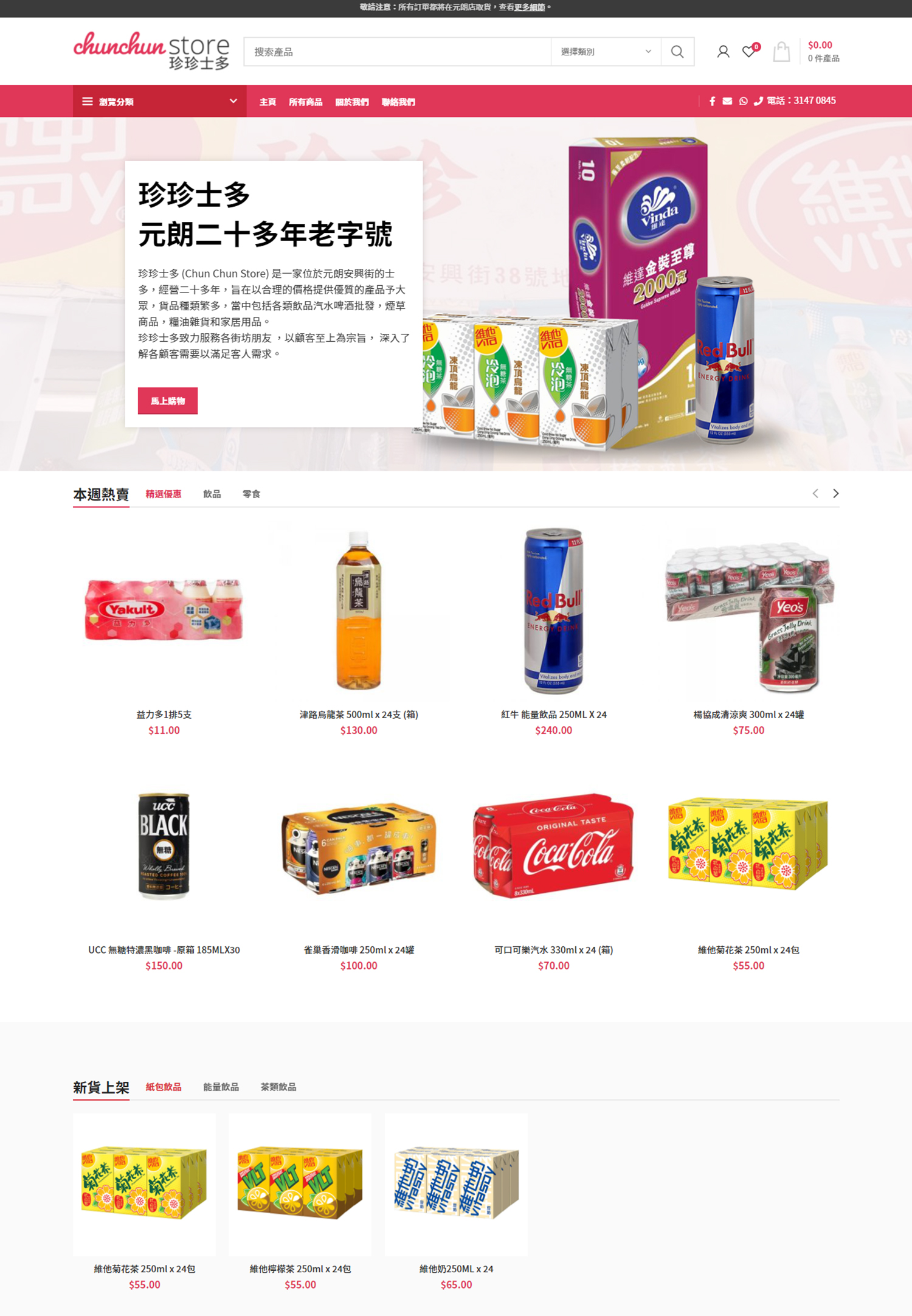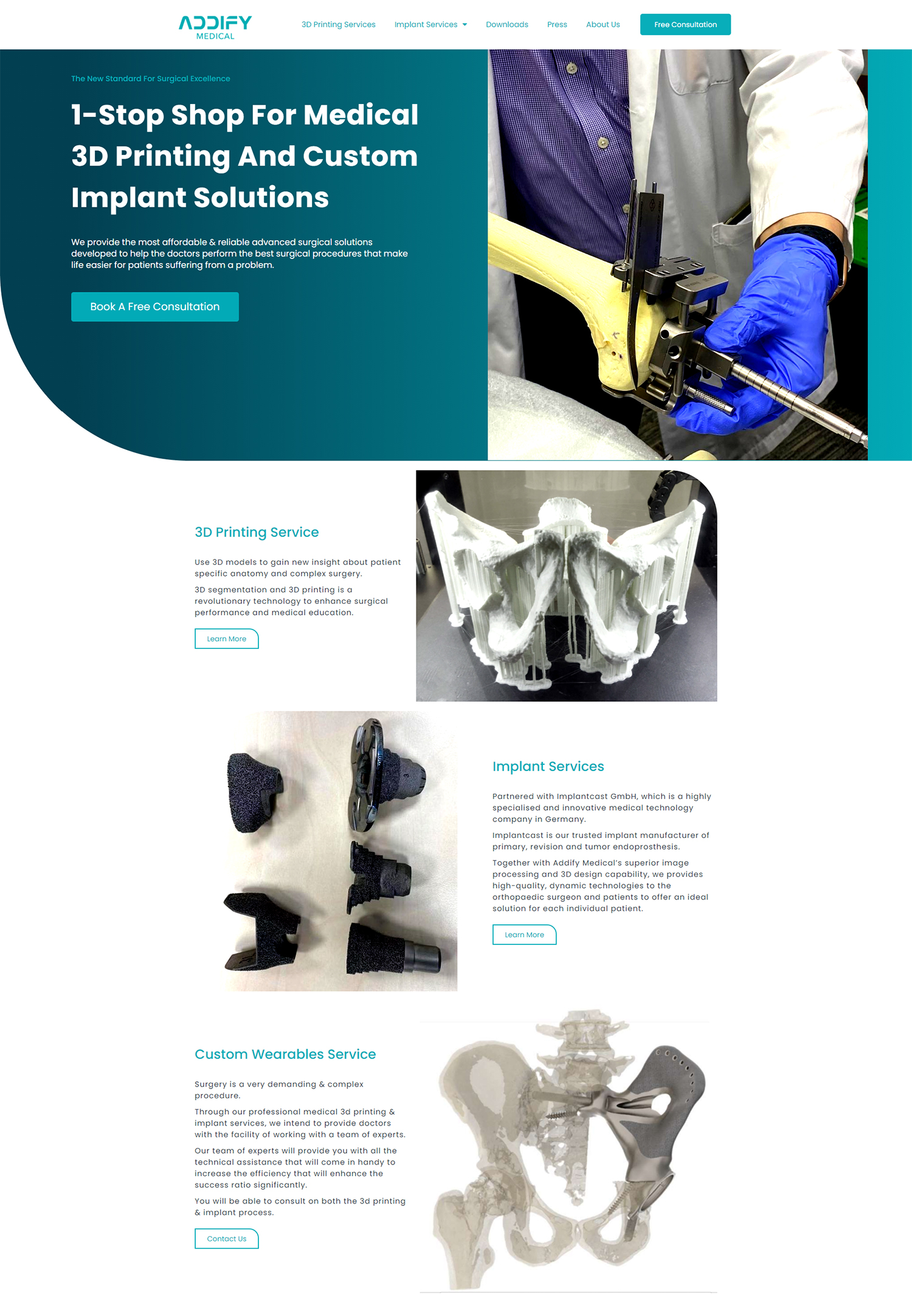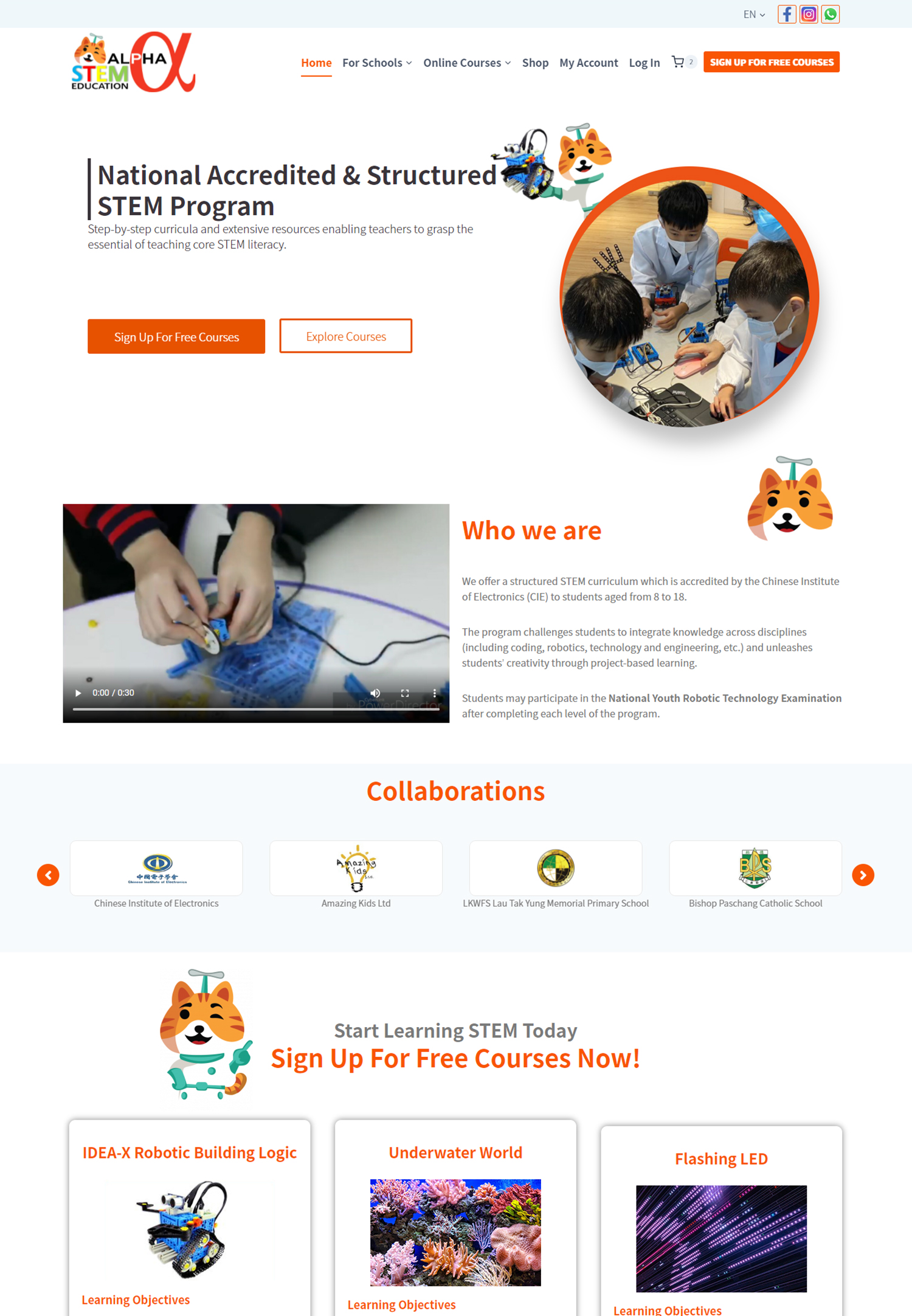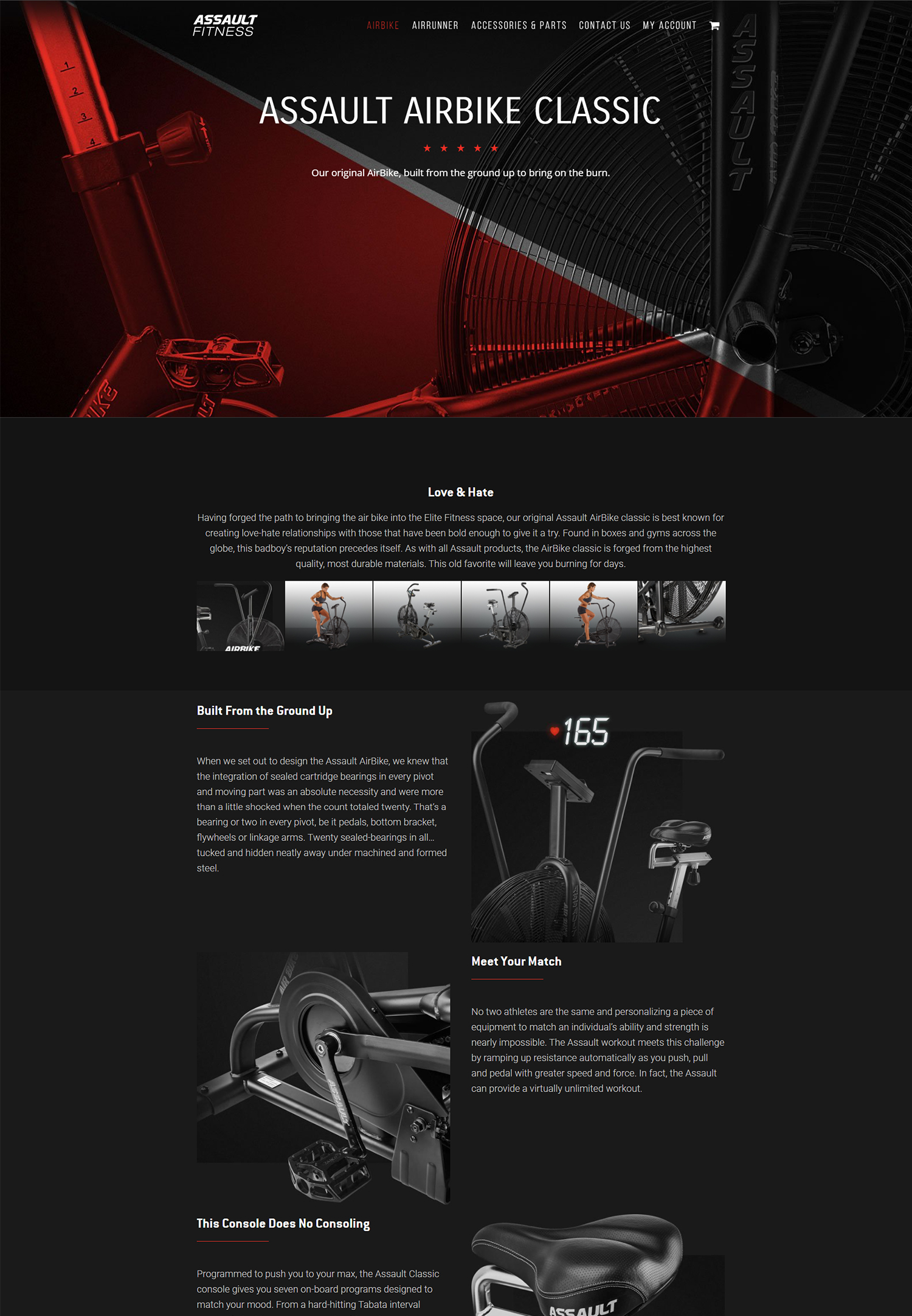


What if your website looks polished but still sends potential customers elsewhere? For Hong Kong service businesses, design only earns its keep when it builds trust and makes the next step clear. Effective web design for service businesses HK starts with the customer’s path to a qualified enquiry, not a collection of attractive pages.
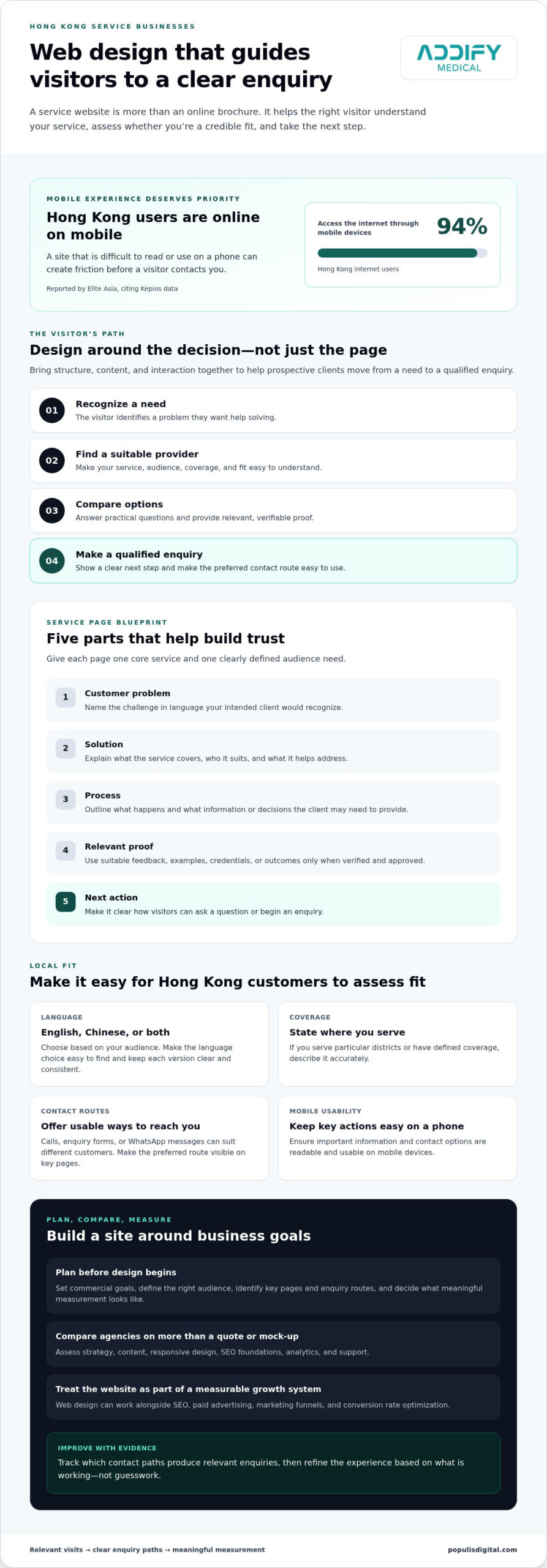
It’s reasonable to ask which features actually generate enquiries, whether a stylish site can deliver leads, and how to serve local customers across devices and languages. Mobile experience deserves priority: Elite Asia, citing Kepios data, reports that 94% of Hong Kong internet users access the internet through mobile devices. A site that’s hard to read or use on a phone can create friction before a visitor even contacts you.
This guide shows you how to plan, assess, and improve a website around your service, ideal customer, and business goals. You’ll learn what supports trust and conversion, how SEO, funnel planning, and conversion rate optimization fit into the picture, and what to assess when comparing agencies. The aim is to help you turn relevant visits into clear enquiry paths, then measure what’s working.
Key Takeaways
- Build your website around the visitor’s journey from recognizing a need to making a qualified enquiry, not just around visual polish.
- Structure service pages to explain the customer’s problem, your solution and process, relevant proof, and a clear next step.
- Compare agencies on strategy, content, responsive design, SEO foundations, analytics, and support rather than choosing by quote or mock-up alone.
- Plan web design for service businesses HK by prioritizing commercial goals, the right audience, key pages, enquiry routes, and meaningful measurement.
- See how web design can work alongside SEO, paid advertising, marketing funnels, and conversion rate optimization as part of a measurable growth system.
What Should Web Design for a Hong Kong Service Business Actually Do?
A service-business website is more than an online brochure. It should help the right visitor understand what you do, decide whether you’re a credible fit, and take a clear next step. That makes it a channel for building trust, qualifying potential customers, and generating enquiries, not simply a digital showcase.
A high-performing service-business website guides potential clients from a specific need to a confident, qualified enquiry.
The journey is practical: a visitor recognizes a problem, looks for a suitable provider, compares options, then contacts the business that feels relevant and reliable. Good web design brings structure, content, and interaction together to support that journey. For service businesses, the priority isn’t adding features for their own sake. It’s answering likely questions and removing unnecessary friction before contact.
This differs from an online store, where visitors browse products and complete purchases, and from a content platform, where regular publishing and information discovery may be central. A service website can include useful resources, but its core job is to make expertise and next steps easy to evaluate. For web design for service businesses HK, shape each key page around the visitor’s decision rather than treating every business as a generic company profile.
What do prospective clients need before they make an enquiry?
Visitors need to quickly see what the service includes, who it’s for, where it’s available, and which problem it solves. Broad claims such as “high quality” or “experienced team” rarely answer those questions. Be specific: describe the service, outline what happens next, and set realistic expectations about the process.
Relevant, verifiable proof can reduce uncertainty. This might include suitable client feedback, examples of work, or clear credentials where applicable. Pair proof with a straightforward process so people know what to expect after contacting you. Then make the next action obvious on important pages, whether that’s calling, submitting an enquiry form, or choosing another appropriate contact option. Don’t make visitors hunt for it.
Which Hong Kong customer signals should the site reflect?
Start with your audience, not assumptions. Decide whether prospective clients need information in English, Chinese, or both. Make the language choice easy to find and keep each version clear and consistent. If your business serves particular districts or has defined coverage, state that accurately so visitors can assess fit without relying on a stack of near-identical location pages.
Choose contact routes based on how your customers prefer to act and how your team can respond. Some may want to call; others may prefer a form or WhatsApp message. Make the preferred route visible and usable on key pages, especially on mobile. Track which paths produce relevant enquiries, then refine the experience based on evidence rather than guesswork.
How to Structure Service Pages That Build Trust and Generate Enquiries
A strong service page answers the questions a prospective client is already weighing: Is this for someone like me? Can this provider solve my problem? What happens if I get in touch? Build the page in that order. A clear sequence keeps the message focused and gives visitors a reason to take the next step.
What belongs on a high-converting service page?
Give each page one core service and one clearly defined audience need. If you offer several services, avoid forcing them into one broad page where the details blur together. Use this sequence to guide the reader:
- Customer problem: Name the challenge in language your intended client would recognize.
- Solution: Explain what the service covers, who it suits, and what it helps address.
- Process: Outline the steps involved and what information or decisions the client may need to provide.
- Proof: Add relevant testimonials, examples, credentials, or outcomes only when they’re verified and approved for use.
- Next action: Tell visitors exactly how to ask a question or begin an enquiry.
Specificity earns more confidence than slogans. Instead of saying “We deliver exceptional service,” describe the actual scope, who benefits, and what a client can expect after making contact. Answer practical questions about suitability and what’s included, while avoiding promises you can’t substantiate.
How should calls to action work across the website?
Use consistent, direct wording such as “Request a consultation” or “Ask a question,” then place the action beside content that helps the visitor decide. A contact option belongs near the process, proof, or service details, not only in the footer. Keep forms concise. Ask for the details needed to respond and assess the enquiry, such as the service of interest and a short description of the need. Give every form field a clear purpose.
Make the preferred contact route easy to find on mobile as well as desktop. If you offer calls, forms, or messaging, label each option clearly so visitors know what will happen next. Then use analytics to assess which pages and contact routes lead to relevant enquiries, and refine the path based on observed performance.
For a broader view of how touchpoints can guide prospects toward action, explore this marketing funnel planning guide. A deliberate page sequence is a practical foundation for web design for service businesses HK, connecting visitor intent to measurable enquiry paths. To see how that approach can inform a website project, explore Populis Digital web design.
How to Compare Web Design Agencies for a Hong Kong Service Business
A polished mock-up can win attention, but it can’t prove that the website will attract suitable prospects, make your offer clear, or help your team convert enquiries. The lowest quote can also leave important work out of scope. Compare agencies on the thinking, deliverables, and measurement behind the design, not just how the first screen looks.
Use this framework to assess proposals side by side:
Ask the agency to explain how it defines a qualified enquiry. A form submission alone may not be a useful outcome if it comes from someone outside your target audience or about the wrong service. Ask how the proposed page architecture, content, and contact routes will help visitors assess their fit, and how reporting can distinguish raw activity from relevant leads.
Which questions reveal whether an agency understands service businesses?
Ask how discovery will identify your target customer, strongest offer, and service-area priorities. Request a plain-language walkthrough of the proposed page structure, visitor routes, and measurement plan. Then test the plan against your team’s capacity: if enquiry volume rises, who responds, through which channel, and how quickly can your team follow up? The site should fit the operation behind it.
How can you assess proof without relying on bold promises?
Review case studies, but verify the client, project scope, and reported outcomes before treating them as evidence. Portfolio visuals show design choices; they don’t establish business performance. Look for a clear account of the challenge, work completed, and measurement used. Treat unsupported claims as claims, not proof. For more context on testing and measurement, see this conversion rate optimization guide.
Before agreeing on scope, confirm who owns the website, domain, content, and relevant accounts, and make sure your team will have the access it needs. Put maintenance responsibilities, support arrangements, deliverables, and exclusions in writing. For web design for service businesses HK, a transparent proposal should make clear what’s being built, how success will be assessed, and what happens after launch.
How to Plan a Hong Kong Service Website Before Design Begins
A clear brief turns web design from a series of preferences into a business project with priorities and measures. For web design for service businesses HK, plan around the services that matter most commercially and the actions you want the right visitors to take. Don’t try to give every page equal weight.
What should the website brief include?
Before design starts, align decision-makers on the essentials: business goals, core services, ideal customers, differentiators, and accurate service coverage. Then gather existing content and assets, verified proof you’re authorized to use, internal approvers, and the person responsible for writing or reviewing each page. A focused brief prevents important decisions from being delayed until design is underway.
Use this planning sequence to move from objectives to a measurable site:
- 1. Goals: State the business outcome the website should support, such as generating relevant service enquiries.
- 2. Audience: Define the customers you want to reach and the needs or questions they bring.
- 3. Offer: Clarify the priority services, who each suits, and what makes them relevant.
- 4. Page structure: Map the essential pages to visitor needs. Prioritize the services and pages with the clearest commercial importance.
- 5. Content: Assign responsibility for service explanations, process details, and approved proof.
- 6. Enquiry route: Choose the actions visitors should take and the details your team needs to assess each lead.
- 7. Measurement: Agree how to record enquiry volume and quality, form starts and completions, and the pages or routes that lead to contact.
Set a baseline before launch using data you can reliably collect. Define what makes an enquiry qualified, then record relevant enquiries alongside form completions so you can distinguish activity from useful leads. If you can’t connect a metric to a business question, it may not be the right success measure.
How do SEO and conversion goals fit into the build?
Plan a clear topic and purpose for each priority page, then connect related services and useful information through navigation. This supports discoverability without turning planning into a full SEO audit. Agree which analytics and conversion events matter, such as completed forms or calls, and confirm who will review the data after launch. Broader marketing planning may also benefit from this Hong Kong SEO services guide.
Ready to turn your priorities into a website plan? Explore website design with Populis Digital.
How Populis Digital Connects Service-Business Web Design to Growth
A website performs best as part of a customer-acquisition system, not as a standalone design asset. Populis Digital is a Hong Kong-based agency serving SMEs, with offerings that include web design, SEO, Google Ads Management, Facebook & Instagram Ads Management, marketing funnel creation, and conversion rate optimization (CRO). For web design for service businesses HK, these capabilities can be aligned around a shared objective: helping suitable visitors find relevant information, take an enquiry action, and giving the business a way to assess what happens next.
What makes an integrated website strategy useful?
Each channel should have a clear role. SEO can support discovery through relevant service pages; paid advertising can direct campaign traffic to pages matched to the message; funnel planning can map the steps from initial interest to contact; and CRO can help assess where visitors encounter friction. The value lies in connecting channel, page, and measurable action rather than treating each activity as a separate tactic.
After launch, agreed performance data can inform decisions about page content and conversion paths. For example, if visitors reach a service page but few complete its enquiry form, that may prompt a review of the page’s clarity or form experience. It’s a hypothesis to test, not proof of a cause or a guaranteed outcome. Confirm what analytics will be configured, who reviews results, and whether ongoing optimization is included.
Be precise about scope. Website design and build are project work; SEO, ad management, funnel creation, and CRO may involve ongoing management depending on the agreed engagement. Ask which services are included, what deliverables are defined, and what support or measurement continues after launch.
What should a prospective client do next?
Bring a focused brief to the discussion. Include your core services, target customers, business goals, current website concerns, and any evidence you can share about existing enquiries. Also consider how your team will qualify and follow up with leads. A website can make contacting you easier, but your internal response process remains part of the customer journey.
Populis Digital has experience across healthcare, fitness, education, retail, and real estate. Treat industry experience as relevant context, then ask for project examples and evidence that can be shared and verified. Before approving a recommendation, confirm the proposed scope, the success measures, and what proof supports the plan. A project discussion can cover discovery, design, build, launch, and ongoing measurement, but confirm the actual deliverables and responsibilities rather than assuming a standard process.
Discuss your service-business website with Populis Digital and outline the outcomes you want the site to support.
Turn Your Website Into a Clearer Growth Engine
Effective web design for service businesses HK starts with the customer journey. Make your services, audience, and next steps easy to understand, then build pages that answer buyer questions and guide visitors toward a relevant enquiry.
Plan before design begins. Prioritize the pages with the clearest commercial value, agree how you’ll measure qualified enquiries, and compare agencies on strategy, content, SEO foundations, analytics, and support, not just visual polish. After launch, use performance data to identify where the experience can improve.
Populis Digital is a Hong Kong-based digital agency serving SMEs. Its web design capabilities span company-profile websites, eCommerce, and eLearning, alongside SEO, paid advertising, marketing funnel creation, and conversion rate optimization. These services can support a website as part of a measurable customer-acquisition system, with scope and outcomes defined for your business.
Ready to turn your priorities into a practical plan? Discuss a growth-focused website for your Hong Kong service business. With clear goals and the right strategy, you can build a stronger foundation for earning trust and generating qualified enquiries.
Frequently Asked Questions
What should a service-business website include to generate enquiries?
A service-business website should explain what you offer, who it’s for, how your process works, and how visitors can contact you. Give each priority service a clear page, support claims with relevant verified proof, and make contact options visible near decision-making content. A concise form should request only details your team needs to respond and assess fit. The goal of web design for service businesses HK is to guide qualified visitors toward a clear next step.
How much does web design for a service business in Hong Kong cost?
The cost depends on the project scope, including the number and type of pages, content requirements, language versions, functionality, and integrations. Since each brief differs, ask agencies for an itemized proposal that separates design and build deliverables from optional or ongoing services. Check what’s excluded, who supplies content, and whether post-launch support is included. Compare proposals against your business priorities, not just the headline quote.
How long does it take to build a service-business website?
There’s no reliable timeline without knowing the project scope and how quickly decisions and content can be supplied. A focused site with approved copy may follow a different schedule from a larger build with multiple service pages, language versions, or integrations. Ask the agency for a project schedule with review stages, dependencies, and responsibilities. Confirm what could affect delivery, including delayed feedback or missing content, before work begins.
Should a Hong Kong service business have an English, Chinese, or bilingual website?
Choose languages based on the customers you want to reach and the language they need to evaluate your services and make contact. If your audience uses both English and Chinese, a bilingual site may help, provided you can keep both versions accurate and current. Consider the language of your service descriptions, enquiry forms, and follow-up process. Make language options easy to find, and avoid publishing translated pages that are incomplete or outdated.
Can web design help my Hong Kong business rank on Google?
Yes, web design can support SEO by giving service pages clear topics, useful content, logical navigation, and a usable experience across devices. But design alone can’t guarantee rankings. Search visibility also depends on factors such as the relevance and quality of content and ongoing SEO work. Plan SEO foundations into the build, then assess performance over time. Populis Digital offers SEO alongside web design, so these activities can be considered together.
How do I measure whether my service-business website is working?
Measure whether the site attracts relevant visitors and turns their interest into qualified enquiries. Track form completions and calls where possible, record lead source and service requested, and define what makes an enquiry a good fit. Compare these results with a baseline and review which pages or contact routes contribute. Raw traffic alone isn’t enough; the useful signal is whether the website helps your team connect with potential customers.
Should I redesign my website or improve the existing one?
Improve the current site if it can support your goals and the main issues are limited to specific pages, unclear content, or weak enquiry paths. Consider a redesign if the existing structure or platform prevents important changes, or if the site no longer reflects your services and audience. Start by reviewing performance, usability, content, and technical constraints. A scoped assessment can show whether targeted improvements or a new build is the more practical route.