

Your website doesn’t need a prettier coat of paint. It needs to turn more of the right visitors into enquiries and sales. Choosing website redesign services Hong Kong businesses can rely on means looking beyond visual polish to the strategy behind the site: how it attracts people, guides them and converts interest into action.
If your current website looks dated or underperforms, it may be hard to tell whether the issue is design, usability or marketing. A rebuild can also feel risky when organic rankings and incoming enquiries are already valuable. A strategic redesign should protect what’s working while addressing the friction that is holding growth back.
This guide explains what a conversion-focused redesign should include, how to compare agencies using business-focused criteria, and how to plan a relaunch without treating SEO and existing enquiries as afterthoughts. You’ll also see how design can work alongside SEO, paid advertising, conversion rate optimisation and funnel development, so your next website supports measurable business goals, not just a fresh look.
Key Takeaways
- A dated website doesn’t automatically need a rebuild. Assess qualified enquiries, navigation, mobile usability and service information before deciding.
- Effective website redesign services Hong Kong businesses consider should connect research, structure, design and launch planning to clear business goals.
- Compare agency proposals against the same objectives and deliverables, including strategy, SEO, analytics, communication and support.
- Plan the relaunch in stages. Audit valuable content, URLs, search signals, analytics and lead-handling processes before launch.
- Consider how web design, SEO, paid advertising, CRO and marketing funnel creation can work together to support measurable growth.
When Does a Hong Kong Business Need Website Redesign Services?
A dated website isn’t automatically a reason to rebuild. If it still attracts qualified visitors, explains your offer clearly and helps people take the next step, a visual refresh may be enough. The case for change is stronger when qualified enquiries are declining, navigation leaves visitors unsure where to go, mobile pages are difficult to use, or service information no longer reflects what your business offers.
These symptoms can point to different problems. Weak enquiries may come from low-quality traffic or an unclear offer, not the design itself. If visitors abandon a key page, the cause could be confusing content, a broken interaction or friction in the customer journey. Effective website redesign services Hong Kong businesses consider should begin with diagnosis, not assumptions based on appearance.
How to tell whether your website is underperforming
Start with business objectives. Review enquiry quality, completed actions such as form submissions or purchases, and where visitors abandon important journeys. Compare these patterns with your own past performance and goals rather than treating a single metric as a verdict.
Then test the experience from a customer’s perspective. Can someone quickly understand what you offer, why your business is relevant and what to do next? The disciplines behind web design principles, including user experience and interface design, can help frame that review. Analytics can show where users drop off; customer feedback can reveal why. A dated visual style alone proves neither success nor failure.
Before deciding, record a baseline: leads, sales, traffic and the conversion actions that matter to your business. Note how enquiries arrive and whether the right people are contacting you. This gives you a reference point for evaluating changes and helps distinguish a site problem from shifts in traffic quality or the offer itself.
Redesign, refresh, or optimise: which route fits?
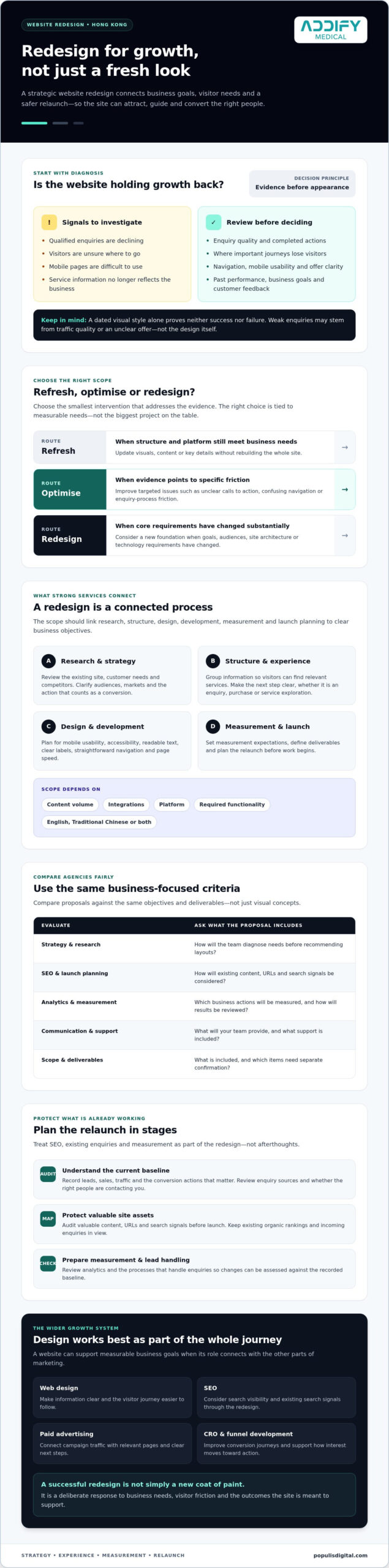
Choose the smallest intervention that addresses the evidence. A refresh suits a site whose structure and platform still meet business needs but whose visuals, content or key details need updating. Optimisation is more targeted. Use it when evidence points to specific issues, such as unclear calls to action, confusing navigation or friction in an enquiry process.
A full redesign makes more sense when business goals, audiences, site architecture or technology requirements have changed substantially. For example, a business expanding its services may need a different way to organise content, while a site that cannot support required functionality may need a new foundation. Before committing, identify the actual constraint and confirm that the proposed scope solves it. The right decision is the one tied to measurable needs, not the biggest project on the table.
What Should Website Redesign Services in Hong Kong Include?
A strategic redesign is more than a new visual layer. It connects research, site structure, design, development, measurement and launch planning to defined business objectives. The scope should reflect what the website needs to do, whether it’s presenting a company profile, supporting eCommerce or generating enquiries through focused landing pages. As Website Redesign: The Ultimate Guide also emphasises, a redesign should serve business goals, not design preferences alone.
Before work begins, clarify who the site needs to reach, which Hong Kong service areas or markets matter, whether content should be available in English, Traditional Chinese or both, and what action counts as a conversion. Scope also depends on content volume, integrations, platform and required functionality. Ask the agency to state what’s included, what your team must provide and which items need separate confirmation.
Strategy, structure, and user experience
Ask how the agency will review your existing site and research customer needs and competitors before recommending layouts. A clear information architecture groups content so visitors can find relevant services without guesswork. Visual choices should then reinforce trust and make the next step obvious, whether that’s submitting an enquiry, making a purchase or exploring a service. Ask how each proposed page supports those journeys.
Design should also account for mobile usability, accessibility and page speed. Check how the proposed experience handles small screens, readable text, clear labels and straightforward navigation. These are practical evaluation points, not performance promises. Ask how the agency will test them and what criteria it will use.
SEO, analytics, and technical planning
Set measurement expectations before the rebuild. Agree on a baseline for organic traffic, important landing pages, enquiries and other conversion events, then confirm how those metrics will be tracked after launch. SEO planning should cover a URL inventory, redirect mapping for changed addresses, metadata, internal links and indexability. These steps help protect useful search signals, but no redesign can guarantee rankings.
Put the technical boundaries in writing. Confirm the platform, integrations, content ownership, responsibilities for testing and launch, and who handles post-launch fixes or updates. Also ask how mobile behaviour, accessibility considerations and page speed will be checked. Clear deliverables make proposals easier to compare and reduce the chance of mismatched expectations.
For Hong Kong businesses seeking coordinated web design and digital marketing capabilities, Populis Digital’s web design and SEO services are relevant to consider alongside your project requirements.
How to Compare Website Redesign Agencies in Hong Kong
Agency proposals are only comparable when they solve the same business problem. Give each shortlisted provider the same objectives, target audience and requested deliverables, then assess the proposed process, not just the visual promise. A polished mock-up can catch attention. A stronger partner can explain how each design decision supports a user action, such as finding a service, submitting an enquiry or completing a purchase.
Use a consistent scorecard for website redesign services Hong Kong providers:
| Area | What to verify |
|---|---|
| Strategy | How research and business goals shape the proposed site. |
| Design | How layouts support clarity, trust and the intended user journey. |
| Development | Which platform, functionality and integrations are included. |
| SEO | How existing search visibility, URLs and redirects will be handled. |
| Analytics | Which baseline metrics and conversion events will be tracked. |
| Communication | Who makes decisions, gives feedback and coordinates project stages. |
| Support | What handover and post-launch responsibilities are included. |
Questions to ask before choosing a redesign partner
Get responsibilities in writing. Ask who owns research, content, design, development, testing and launch coordination, and what your team needs to supply or approve. Clarify how the agency will account for existing search traffic, plan redirects, preserve analytics and respond if an issue appears at launch. Ask for relevant project examples, then confirm exactly which parts the agency completed. This helps you assess the work itself, not just the presentation.
How to evaluate proposals beyond the visual mock-up
Look for a complete route from visitor intent to conversion. Does the proposal explain the navigation, key pages and calls to action? Does the technical scope match your requirements? Is there a clear measurement plan to evaluate whether the redesigned experience supports your business goals?
Compare the practical terms too: content responsibilities, feedback rounds, testing expectations and handover. If one proposal includes SEO planning and analytics while another focuses only on design, they aren’t equivalent, even if both use the same headline description. Ask agencies to clarify gaps before comparing.
Finally, separate documented evidence from projections. Request examples that show relevant work and ask how results were measured, but don’t treat forecast gains or promised outcomes as guaranteed. A credible proposal makes its assumptions visible and explains how performance will be assessed after launch.
How to Plan a Website Redesign Without Losing Momentum
A relaunch should move the business forward without breaking the systems that already generate visibility, enquiries or sales. Treat it as a controlled transition: assign decision-makers and content owners early, record current performance, and make each stage accountable. A clear process helps your team and your chosen website redesign services Hong Kong partner protect valuable assets while building the new experience.
Before development: establish the baseline
Start by documenting what the current site does and what the business needs next. Name one person who can consolidate feedback and approve decisions, then assign owners for content and internal reviews. This reduces conflicting instructions and helps prevent key pages from stalling while teams wait for direction.
- Define objectives. Set business priorities, target audiences and the actions the redesigned site should support, such as qualified enquiries or completed purchases.
- Audit assets. Inventory important pages and existing URLs, along with analytics events, forms, content and third-party integrations. Record organic visibility, traffic, enquiries and sales indicators wherever tracking exists.
- Confirm scope. Agree on the platform, functionality, content responsibilities, approval process and measurement plan before development begins. Identify which existing content and search assets should be retained, improved or retired.
- Build and test. Review the site as it takes shape. Test key pages, forms, integrations and tracking against the agreed requirements before launch.
- Launch and monitor. Check the deployed site, then monitor agreed technical checks and business metrics to identify issues and prioritise fixes.
At launch: test the complete customer journey
Don’t stop at checking whether the homepage loads. Test navigation and important pages across device layouts, submit forms, confirm tracking events and verify that lead-handling processes still work. After deployment, check redirects, internal links, indexability and analytics configuration. If a URL changes, verify that its redirect leads visitors and search engines to the relevant replacement page.
Use evidence to guide post-launch decisions. Compare performance with the baseline and investigate meaningful changes in traffic, enquiries or completed actions before making adjustments. Fix technical or journey-blocking problems first; defer cosmetic preferences that don’t affect agreed objectives. For a structured approach to post-launch testing and ongoing performance improvements, see Conversion Rate Optimization HK.
For businesses planning a rebuild, Populis Digital’s web design and marketing services can be considered alongside the project’s technical and business requirements.
Choose a Hong Kong Redesign Partner That Connects Design to Growth
The right redesign partner starts with business goals, not a preferred colour palette. Look for an evidence-led scope that addresses real user needs, protects valuable search assets and defines how performance will be evaluated. That’s the standard to apply when comparing website redesign services Hong Kong businesses may consider: every major design decision should connect to a business objective or a measurable user action.
Project scope and outcomes depend on your business, existing website and agreed requirements. Confirm what the work includes before committing, and distinguish proposed deliverables from projected results. A redesign can create a stronger foundation for growth, but outcomes depend on more than design alone.
When an integrated digital agency is the right fit
A standalone visual update may suit a site that needs limited design changes. But if your growth plan also involves attracting qualified traffic, improving conversion paths and connecting campaigns to the website, coordinated capabilities can help keep those efforts aligned. Populis Digital offers web design, SEO, paid advertising, conversion rate optimisation (CRO) and marketing funnel creation. Marketing funnel strategy can connect customer touchpoints into a more deliberate journey.
This integrated approach may suit Hong Kong SMEs looking for a connected customer acquisition system rather than a visual refresh in isolation. Ask how the proposed work links audience needs, landing pages, traffic sources and conversion actions, and which elements are actually included in the project.
Your next steps before requesting a proposal
Make the first project conversation more productive by preparing a concise brief. Include:
- Your business goals and priority audiences.
- Available performance data, such as traffic, enquiries and sales indicators.
- Known website problems and important pages to retain or improve.
- Required functionality, integrations and content support.
- The people responsible for decisions, content and approvals.
With these details in hand, you can compare recommendations against your actual needs and ask sharper questions about scope, measurement and responsibilities. The goal isn’t to buy the largest rebuild. It’s to choose a plan that addresses the right constraints and gives your team a clear way to assess progress.
For project enquiries, Populis Digital’s Hong Kong digital marketing agency team can discuss your website redesign requirements.
Turn Your Redesign Into a Clear Growth Plan
A website redesign should earn its place by solving a business problem, not simply making the site look newer. Start with evidence: identify where visitors struggle, define the actions that matter, and choose a scope that fits your goals. Then protect valuable content, URLs and measurement through a carefully planned launch.
Choosing among website redesign services Hong Kong providers is easier when you compare their strategy, responsibilities and evaluation plan against the same business priorities. Look for a partner that can connect the website experience with customer acquisition and conversion, while being clear about what the project can and can’t promise.
Populis Digital is a Hong Kong-based digital marketing agency serving SMEs across multiple industries. Its web design capabilities can be coordinated with SEO, paid advertising, conversion rate optimisation and marketing funnel creation, helping businesses consider the full journey from traffic to action.
Bring your goals, known site issues and performance data to the next conversation. Discuss your website redesign with Populis Digital and take a confident first step toward a site built around measurable business priorities.
Frequently Asked Questions
How much do website redesign services cost in Hong Kong?
Website redesign costs in Hong Kong depend on the project’s scope, not a single standard rate. A company profile site, an eCommerce website and a site with complex integrations require different work. Ask agencies for an itemised proposal that defines pages, functionality, content responsibilities, SEO tasks and launch support. Compare proposals against the same requirements, and confirm whether requested additions or changes fall outside the agreed scope.
How long does a website redesign take?
The timeline depends on the site’s size, content volume, functionality, integrations and how quickly decisions and materials are provided. A focused refresh involves a different level of work from a rebuild with new architecture or eCommerce requirements. Ask the agency to break the project into stages, identify review and approval points, and clarify what could affect delivery. Assign decision-makers and content owners early to reduce avoidable delays.
Will a website redesign affect my Google rankings?
A redesign can affect Google rankings if it changes URLs, removes useful content, disrupts internal links or makes pages difficult to crawl. Reduce avoidable risk by inventorying important URLs, mapping redirects where addresses change, retaining relevant content and checking indexability after launch. Record organic traffic and key landing-page performance before the rebuild so you can monitor changes. No agency can guarantee that rankings will remain unchanged.
Should I redesign my website or just update it?
Update or refresh the site if its structure and platform still support your business but its content or visual presentation needs work. Choose targeted optimisation when evidence points to specific issues, such as confusing navigation or a form that visitors abandon. A full redesign is more appropriate when your audience, business goals, site architecture or technology needs have substantially changed. Base the decision on evidence, not appearance alone.
What should I look for in a Hong Kong website redesign agency?
Look for a clear process that connects business goals to research, design decisions, technical scope and measurement. Ask who handles content, development, testing, SEO and launch coordination, and request relevant project examples with a clear explanation of the agency’s role. Compare proposals using the same deliverables, including communication and handover. The right website redesign services Hong Kong partner should explain how the site will support user actions without promising unverified results.
Can I keep my existing website content during a redesign?
Yes, useful content can often be retained, revised or reorganised as part of a redesign. First identify high-value service pages, landing pages and resources, then assess whether each still reflects your offer and audience. Preserve important URLs where practical; if an address must change, plan an appropriate redirect. Confirm who owns content review and migration, and make sure the scope states which writing or editing tasks are included.
Is SEO included in website redesign services?
SEO may be part of a redesign proposal, but inclusion and depth vary by agency and project. Ask specifically whether the scope covers URL inventory, redirect planning, metadata, internal links, indexability checks and baseline performance tracking. Don’t assume a design project includes ongoing SEO management. Populis Digital offers Search Engine Optimization (SEO) alongside web design, but confirm the deliverables for your project before work begins.
Can a website redesign generate more leads?
A redesign can support lead generation when it makes your offer easier to understand, improves the visitor journey and guides relevant prospects toward a clear enquiry action. Results also depend on traffic quality, the strength of the offer and how enquiries are handled. Set a baseline for qualified enquiries and conversion actions before launch, then measure performance afterward. Treat lead growth as an objective to test, not a guaranteed outcome.