

A translated website can still create two broken customer journeys. Effective bilingual web design Hong Kong businesses can rely on takes more than swapping English copy for Traditional Chinese. Navigation, page layouts, search visibility and conversion paths all need to work naturally in both languages.
If you’re weighing separate URLs against subdirectories, or wondering whether a language switcher will take visitors to the right page, you’re asking the right questions. A bilingual site can be straightforward to maintain, but only when its structure is planned before development begins. Translation alone won’t make the experience relevant to local customers.
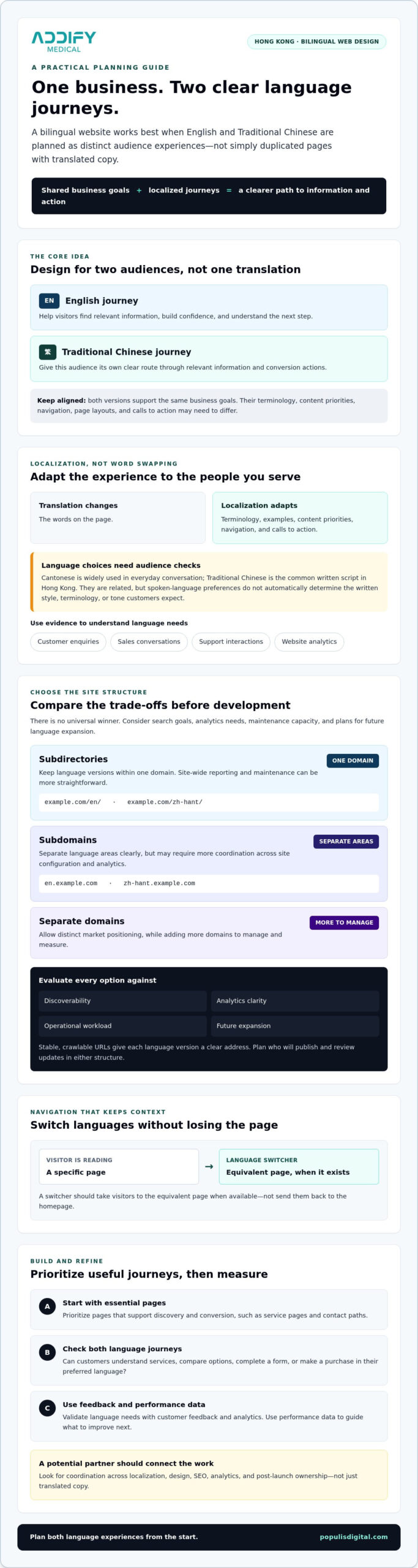
This guide explains how to choose a practical site structure, shape coherent English and Traditional Chinese journeys, and build SEO and conversion measurement into your plan. You’ll learn how to coordinate localized content, navigation and calls to action without duplicating effort or disconnecting the experience. The aim is a maintainable website that helps visitors from both language audiences take a clear next step.
Key Takeaways
- Plan English and Traditional Chinese as distinct audience journeys, not as one website with translated copy.
- Compare subdirectories, subdomains and separate domains against your SEO goals, analytics needs and maintenance capacity.
- Use bilingual web design Hong Kong planning to keep both language versions coherent while localizing content and conversion paths.
- Prioritize essential pages and conversion actions before expanding the site, then refine performance using clear measurement.
- Evaluate potential partners on how they coordinate localization, design, SEO, analytics and post-launch ownership.
Bilingual Web Design in Hong Kong Starts With Two Distinct Audience Journeys
A bilingual website is not one set of pages duplicated in another language. It’s a planned, designed and maintained experience in two languages, with each version helping its audience find information, build confidence and take the next step. For Hong Kong businesses, official languages in Hong Kong include Chinese and English, but that doesn’t mean every customer uses the same language or expects the same journey.
Translation changes the words. Localization adapts the experience, including terminology, examples, content priorities, navigation and calls to action. A literal translation may be accurate but still feel awkward or unclear. For example, one audience may need a detailed service explanation before enquiring, while another may look first for a concise overview and a direct contact option. Treat these as hypotheses to test, not assumptions to build into the design.
Strong bilingual web design Hong Kong businesses can use connects both versions to the same business goals while giving each audience a clear route to them. Make important information easy to find, use familiar language, and check that the next action is obvious on both versions. This supports trust, organic discovery and conversion without forcing both journeys into identical layouts or copy.
What does bilingual website localization mean for a Hong Kong business?
Localization starts with the people you serve. Identify customer groups, service areas and preferred languages using evidence from enquiries, sales conversations, support interactions and website analytics. Then adapt page content and calls to action to the questions those audiences need answered and the actions they need to take. For example, review whether a service page clearly explains what is included and how to enquire in each language.
Keep spoken and written language distinct in your planning. Cantonese is widely used in everyday conversation, while Traditional Chinese is the common written script in Hong Kong. They’re related, but they aren’t interchangeable: spoken-language preferences don’t automatically tell you which written style, terminology or tone customers expect on a website. Check these choices with your audience and language reviewers.
When does a business need an English and Chinese website?
Look at where language affects a real customer task. Do enquiries, purchases or support conversations happen in both English and Chinese? Can customers in each key segment understand your services, compare options, complete a form or make a purchase in their preferred language?
If one language journey leaves out essential information or actions, that’s a gap to investigate. Language needs vary by business and audience, so validate the case with customer feedback and analytics before committing to a full bilingual build. Start with pages that support discovery and conversion, such as service pages and contact paths, then use performance data to guide what you improve next.
Choose a Bilingual Website Structure That Supports Hong Kong SEO
Your URL structure affects how visitors move between languages, how your team maintains pages and how clearly you can measure organic performance. There’s no universal winner for bilingual web design Hong Kong businesses can apply without context. Compare each option against your current resources, search goals and plans for future language expansion before development begins. Also consider who will publish and review updates, since every structure needs consistent page maintenance.
How should English and Traditional Chinese URLs be organized?
Common patterns include language-specific subdirectories, such as example.com/en/ and example.com/zh-hant/; subdomains, such as en.example.com and zh-hant.example.com; or separate domains for each language. Each can work, but the trade-offs differ.
- Subdirectories: Keep languages within one domain and can make site-wide reporting and maintenance more straightforward.
- Subdomains: Separate language areas clearly, but can require more coordination across site configuration and analytics.
- Separate domains: Allow distinct market positioning, but create more domains to manage and measure.
Before committing, compare each option for discoverability, analytics clarity, operational workload and future expansion. Stable, crawlable URLs give each language version a clear address. A language switcher should take visitors to the equivalent page when it exists, not send them back to the homepage. If there’s no equivalent, direct them to a relevant page or explain that the content isn’t available in that language. Confirm implementation details with your technical team before launch.
How can bilingual pages remain clear to search engines?
Give each language version its own URL, then ensure the page’s title, metadata, headings and body content match its language. Avoid relying on a switcher or automatic redirects as the only way for search engines and visitors to find the other version. Google’s multilingual SEO best practices explain technical considerations such as language annotations like hreflang. Validate their implementation, along with canonical tags and sitemap setup, for your specific site.
Use Google Search Console to review indexing and search performance by language-specific URL groups. If one version isn’t appearing as expected, check that its pages are available to crawlers, linked from relevant pages and using consistent technical signals before changing the whole structure. For the broader organic strategy behind bilingual visibility, explore this Hong Kong SEO services guide.
Choose the structure your team can maintain consistently, then assess it against business goals and performance data. A Hong Kong business weighing SEO, design and conversion priorities can also review Populis Digital’s digital marketing capabilities as part of its planning.
Will Bilingual Web Design Confuse Customers or Dilute Conversions?
No. Two language versions can support one coherent brand and conversion strategy when each journey is planned deliberately. The risk isn’t having two versions. It’s letting them drift: an offer appears on one page but not its counterpart, a form asks for different information, or a call to action promises a different next step. Those mismatches create doubt just when a visitor is deciding whether to trust you.
Hong Kong’s official languages are Chinese and English, but your own customers’ language preferences should guide what you build and how you measure it. Effective bilingual web design Hong Kong companies can use keeps essential information and the core brand promise aligned, while adapting language and content to each audience.
How do you keep both language versions consistent without making them identical?
Set shared rules for what must match, such as the service scope, pricing where applicable, eligibility, key terms and intended outcome. Then adapt terminology, examples and calls to action where audience research supports a different approach. Consistency means both versions make the same promise, not that they use identical wording or page layouts.
Assign ownership for reviewing updates. When a promotion, service detail or form changes, flag its counterpart for review too. A short content checklist can cover the offer, key terms, form fields and calls to action, helping teams catch differences before publishing and keep both journeys accurate over time.
What should businesses measure on each language version?
Track outcomes by page language, not just total site conversions. Compare equivalent landing pages and paths to relevant actions, such as enquiries, purchases, bookings or completed forms. Review engagement and navigation patterns to identify where visitors hesitate or leave. Don’t assume one language version will outperform the other; use data to locate friction and test a specific improvement.
- Check the full path: Measure landing-page engagement, progression to key pages and completed actions.
- Inspect form performance: Compare starts with submissions, and review whether fields or instructions create avoidable effort.
- Test with purpose: Change one element at a time, such as CTA wording or form guidance, and evaluate the result against the same conversion goal.
Conversion rate optimization gives this work a repeatable process: identify a friction point, form a testable hypothesis, then assess results before rolling out a change. Explore the conversion rate optimization guide for a structured approach. That’s how you protect a consistent brand while improving each audience journey based on its own evidence.
How to Plan and Launch a Bilingual Website in Hong Kong
A controlled rollout is more practical than translating every page at once. For bilingual web design Hong Kong businesses can manage and measure, work from evidence, prioritize pages that support customer decisions, and assign clear owners before production starts. Project scope and timing depend on factors such as content volume, integrations and approval workflows, so define those early rather than assuming both language versions are equally simple to deliver.
What should the bilingual website project brief include?
Start with a project brief that connects audience needs to business outcomes. Document target customer groups, language requirements, primary goals and the actions visitors should complete, such as submitting an enquiry or making a purchase. Inventory existing pages and label each one for translation, localization, consolidation or new content. For each priority page, note its purpose, the information it must include and its intended next action. Then name who owns copy review, technical implementation, analytics and final approval in both languages.
Build the project in sequence:
- Research audiences and validate language preferences using customer and analytics evidence.
- Set scope, choose priority pages and define success measures for each language journey.
- Prepare and review content, then design and build with real English and Traditional Chinese copy.
- Test both versions, launch, and use performance data to guide ongoing improvements.
How should businesses test both language versions before launch?
Test the real experience, not just the words. Check navigation, forms, links and language switching across equivalent journeys. Review layouts with actual copy because English and Traditional Chinese can occupy space differently. Test mobile views, readability and accessibility, then confirm analytics events record key steps and completed actions correctly. Ask someone who hasn’t worked on the build to complete a typical task in each language, such as finding a service detail and submitting an enquiry. Fix broken links, awkward text wrapping and form errors before publishing.
How can the site improve after launch?
After launch, review search visibility, navigation paths and conversion data separately for each language. Look for observed friction, such as visitors leaving a key page or abandoning a form, and prioritize revisions based on evidence rather than assumptions about language preference. If follow-up messaging is part of the journey, map how visitors move from initial interest toward an enquiry or purchase. This marketing funnel strategy guide can help frame those next steps.
Planning a bilingual project? Discuss your website strategy with Populis Digital and connect design decisions to SEO, conversion goals and ongoing measurement.
Choose a Hong Kong Bilingual Web Design Partner That Connects Design to Growth
A strong partner should connect language decisions to the full customer acquisition journey, from how visitors find a page to the action they take next. When assessing bilingual web design Hong Kong businesses need, look beyond visual polish. Check whether the proposed team can coordinate localization, web design, SEO, analytics and conversion goals, and clarify who owns each part after launch.
What questions should you ask a bilingual web design agency?
Use a focused checklist to compare agencies on their process, not just their pitch. Ask:
- Localization: How do you research language-specific needs, review content and check each page for accuracy and usability?
- Design and development: How do content, design and development teams work together, and how do they test both language versions?
- SEO and analytics: Who plans the URL structure, search setup and measurement for each language?
- Ongoing ownership: Who handles future content changes, language review and post-launch performance checks?
- Scope and proof: Can you share relevant project examples or references, and specify which services are included in the proposed scope?
Look for clear answers about page-level quality assurance and accountability. A partner should be able to explain how a content update moves through review, implementation and measurement, rather than leaving you to coordinate separate teams without a defined process. Verify that portfolio examples are relevant to your needs, and ask what role the agency played in each project.
How does Populis Digital connect website design with marketing performance?
Populis Digital is a Hong Kong-based agency serving SMEs, with capabilities in web design, SEO, conversion rate optimization and marketing funnel creation. These disciplines can work together: page structure supports discovery, design guides visitors toward relevant actions, and measurement helps identify where the experience may need refinement. The right scope depends on your audience, current website and business goals, so confirm deliverables and responsibilities before work begins.
Choose a partner prepared to connect design decisions with measurable actions, not promise a particular ranking or conversion result. Bring your audience languages, priority customer journeys and current performance data into the discussion. Discuss your bilingual website project with Populis Digital to explore how web design, SEO and conversion rate optimization could fit your goals.
Turn Your Bilingual Website Plan Into a Growth Engine
A bilingual website performs best when both language versions guide visitors through clear, locally relevant journeys. Choose a URL structure your team can maintain, keep essential offers and information aligned, and adapt content where audience needs call for it. Then track engagement and completed actions by language so ongoing improvements follow evidence, not assumptions.
That’s the strategic foundation of effective bilingual web design Hong Kong businesses can build on: connected design, SEO and conversion measurement. The right partner should make the process clear, from audience research and content review to launch checks and post-launch optimization.
Populis Digital is a Hong Kong-based digital agency serving SMEs, with capabilities in web design, SEO, conversion rate optimization and marketing funnel creation. Its experience spans healthcare, fitness, education, retail and real estate. Discuss your bilingual website strategy with Populis Digital and explore how your current site can better serve both English- and Chinese-speaking audiences.
Make each language journey work harder for your business, and give every visitor a confident next step.
Frequently Asked Questions
What is bilingual web design?
Bilingual web design plans, builds and maintains a website experience in two languages, rather than simply duplicating pages with translated text. For bilingual web design Hong Kong businesses need to consider how each audience finds information, understands the offer and completes key actions. That includes suitable navigation, page content, language switching, mobile layouts and search setup for each language version, all connected to the same core business goals.
Should a Hong Kong website use English and Traditional Chinese?
Use English and Traditional Chinese if your customers, enquiries or sales indicate a need for both. Chinese and English are Hong Kong’s official languages, and Traditional Chinese is commonly used for written content locally. Still, don’t assume every business needs two complete versions or that all visitors share the same preferences. Review customer conversations, sales and support interactions, and website analytics to decide which audiences and tasks each language version should serve.
Is translating a website enough to localize it for Hong Kong?
No. Translation converts wording, while localization adapts the experience to the audience. Review terminology, examples, information priorities, calls to action and forms so they feel relevant and clear to Hong Kong customers. Also distinguish spoken Cantonese from written Traditional Chinese: they’re related, but one doesn’t automatically determine the right written style or tone. Have local language reviewers check meaning and usability, not just word-for-word accuracy.
How should English and Chinese pages be structured for SEO?
Give each language version a stable, crawlable URL, using subdirectories, subdomains or separate domains according to your goals and maintenance capacity. Make sure titles, metadata, headings and page content match the language of each URL. Where equivalent pages exist, connect them appropriately and validate technical details such as hreflang. Monitor indexing and organic performance by language-specific page groups in Google Search Console, then investigate issues at the page level.
Can one bilingual website rank in both English and Chinese search results?
Yes, a bilingual website can be eligible to appear for relevant English and Chinese searches if each version is accessible to search engines and provides useful, language-appropriate content. Use distinct URLs and align each page’s copy and metadata with its intended audience and search intent. Technical setup and content quality matter, but rankings aren’t guaranteed. Track impressions, clicks and indexed pages by language in Google Search Console to see how each version is performing.
How do you measure whether a bilingual website is converting?
Measure completed business actions separately for each language, such as enquiries, purchases, bookings or submitted forms. Compare those outcomes with visits to relevant landing pages, engagement and navigation paths to spot where visitors drop off. Check that analytics records equivalent events across both versions before comparing results. Then use conversion rate optimization to test focused changes, such as clearer form instructions or a more relevant call to action, and assess the impact against the same goal.
What should I look for in a bilingual web design agency in Hong Kong?
Choose an agency that can explain how it coordinates localization, design, development, language review, SEO and analytics. Ask who owns URL planning, page-level quality checks, measurement and future updates, and request relevant project examples or references. Confirm exactly which services are included in the proposed scope. Populis Digital is a Hong Kong-based agency serving SMEs, with capabilities in web design, SEO, conversion rate optimization and marketing funnel creation.