

Stop treating your marketing as a creative experiment and start treating it as a high-performance growth engine. Implementing a winning digital growth strategy for SMEs in 2026 isn’t about “trying” new platforms; it’s about architecting a psychological funnel that makes conversion the only logical outcome for your customer. You’re likely tired of watching ad spend evaporate with zero ROI while agencies hide behind technical jargon that doesn’t pay the bills. It’s a common frustration in the competitive Hong Kong market where stagnant lead generation can feel like a death sentence for ambition.
This blueprint is your transition from business stagnation to rapid, predictable success. We’re stripping away the noise to provide the exact data-driven architectures required to dominate the local search landscape and automate your lead generation. You’ll learn how to leverage the latest Google Ads AI Max upgrades and psychological triggers to ensure every dollar spent is an investment, not an expense. We’ll break down the specific frameworks that turn your digital presence into a cold, calculating strategist for your brand’s expansion. It’s time to stop guessing and start scaling.
Key Takeaways
- Identify the “Tactical Trap” that causes most digital initiatives to fail and learn how to build a conversion-focused engine instead of a static website.
- Master the three pillars of a high-performance digital growth strategy for SMEs to turn your marketing into a systematic, automated acquisition machine.
- Move beyond vanity metrics like traffic volume to focus on the data-driven architectures that actually generate predictable revenue and ROI.
- Follow a concrete 5-step roadmap to audit your current performance and engineer offers that your target Hong Kong audience can’t refuse.
- Shift your perspective from hiring service providers to partnering with a growth architect who treats your business expansion as a precise engineering problem.
Why Most SME Digital Growth Strategies Fail in 2026
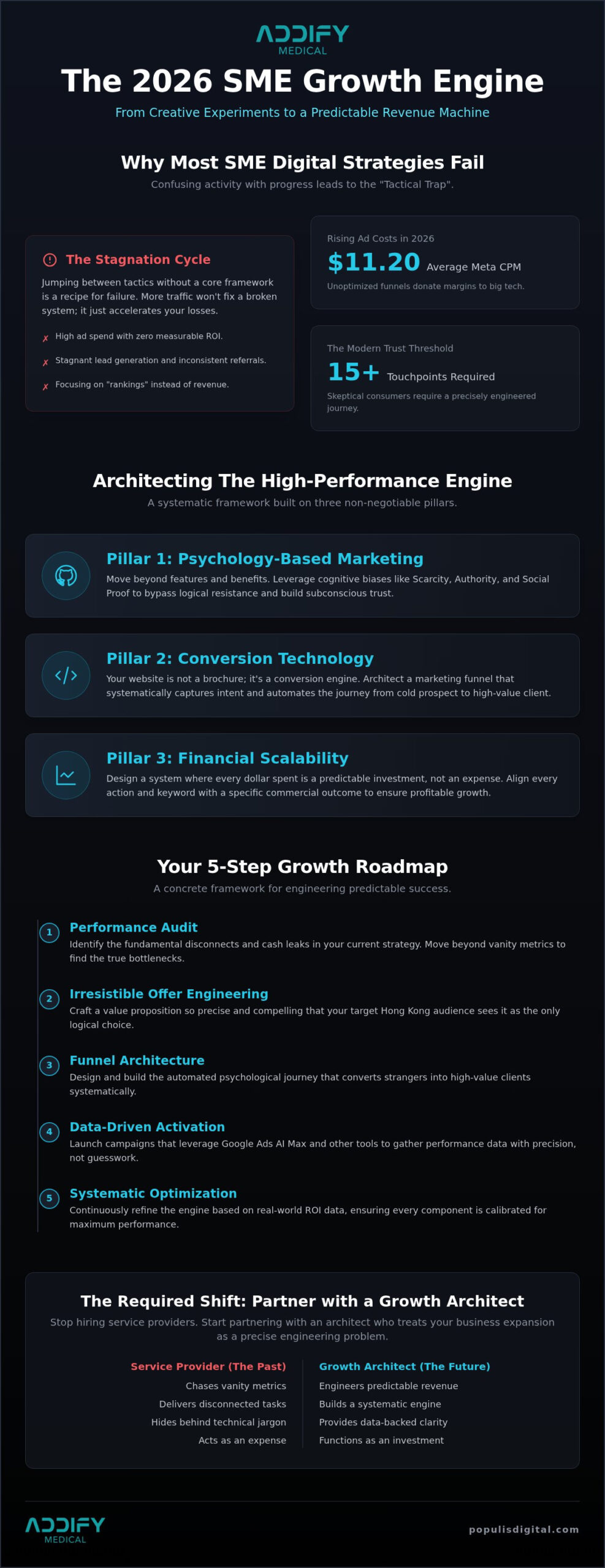
Most SMEs fail because they confuse activity with progress. They fall into the “Tactical Trap,” chasing the latest social media platform while their core infrastructure leaks cash. If you’re jumping from TikTok trends to AI-generated content hubs without a backend framework, you aren’t growing; you’re just busy. Real success in this environment requires a robust digital growth strategy for SMEs that treats every click as a data point in a larger engineering problem. It’s time to stop guessing and start architecting.
In the hyper-competitive Hong Kong market, the traditional website is dead. It’s no longer a digital brochure. It must be a conversion-focused engine designed to capture and nurture intent automatically. With Meta’s average CPM climbing to $11.20 in 2026, unoptimized businesses are simply donating their margins to big tech. If your funnel is broken, “more traffic” won’t save you. It’ll just accelerate your losses. You don’t need more visitors; you need a better system for converting the ones you already have. Investing in high-performance corporate website design Hong Kong is the foundational step that transforms your digital presence from a passive brochure into an active lead generation engine.
The Stagnation Cycle: Identifying the Symptoms
Stagnation isn’t a mystery; it’s a series of measurable failures. High bounce rates on expensive landing pages indicate a fundamental disconnect between your ad copy and the user’s psychological state. If your lead flow relies solely on word-of-mouth or inconsistent referrals, you don’t have a scalable business. You have a gamble. Many founders see a massive gap between technical SEO metrics and actual bank deposits. This happens when agencies focus on “rankings” rather than revenue. A high-performance engine closes this gap by aligning every keyword with a specific commercial outcome.
The 2026 Shift: From Awareness to Psychological Precision
The 2026 consumer is skeptical and over-stimulated. Research shows they now require 15 or more touchpoints before they even consider trusting a new brand. This shift demands moving away from “gut feeling” marketing and toward data-driven decision making. While foundational digital marketing strategies provide the baseline, scaling requires psychological precision. You must architect a journey that anticipates objections and automates trust through every layer of the funnel.
Stop being a passive service provider in your own industry. You need to become a high-performance growth partner. This means utilizing a systematic digital growth strategy for SMEs that prioritizes precision over volume. If you aren’t using data to engineer your customer’s journey, you’re leaving your success to chance. Precision is the only path to dominance.
Architecting the High-Performance Digital Growth Engine
A digital growth strategy for SMEs is not a collection of apps or social media accounts. It’s a systematic, data-backed framework designed to automate customer acquisition at scale. If your current approach feels like a series of disconnected tasks, you don’t have an engine; you have a pile of parts. To scale in 2026, your architecture must rest on three non-negotiable pillars: Psychology, Technology, and Scalability. If any pillar is weak, the entire structure collapses under the weight of rising acquisition costs.
At the center of this architecture is your marketing funnel. This is the spine of your business growth. It’s the logical progression that takes a cold stranger and transforms them into a high-value client. Without this spine, your marketing spend is just noise. With it, every dollar invested becomes a predictable input for a measurable output. This is where we engineer the “Irresistible Offer.” We create a value proposition so precise that it makes your competitors look like a risky, unoptimized alternative.
Psychology-Based Marketing: Winning the Subconscious
Scaling requires moving beyond simple features and benefits. You must leverage cognitive biases like Scarcity, Authority, and Social Proof to bypass logical resistance. In a crowded Hong Kong market, consumers don’t buy what you do; they buy the certainty you provide. By positioning your brand as a “Growth Architect” rather than a mere vendor, you instill an immediate sense of psychological ease in the reader. We build this trust through technical authority and transparent, data-backed results. If you can prove the ROI through engineering rather than persuasion, the sale becomes inevitable.
The Funnel Blueprint: Lead Gen to High-Ticket Conversion
Your funnel must be a relentless machine. At the Top of Funnel (TOFU), we capture intent through aggressive SEO services Hong Kong. This ensures you’re visible exactly when your audience is searching for a solution. Once intent is captured, the Middle of Funnel (MOFU) takes over. Automated CRM sequences and email workflows nurture these leads without human intervention. This maintains momentum while you focus on core operations.
The Bottom of Funnel (BOFU) is where we convert that nurtured interest into high-ticket sales using Conversion Rate Optimization (CRO). This stage is about removing friction and proving value. If you want to see how this engineering looks in practice, consider how a specialized growth partner can take over the heavy lifting of your digital expansion. We don’t just provide a service; we install a high-functioning strategic engine into your business.
Traffic vs. Conversion: The 2026 Strategy Audit
Traffic is the most dangerous vanity metric in your business. If you’re celebrating 10,000 monthly visitors while your bank account remains stagnant, you aren’t winning; you’re losing money on hosting and attention. A high-performance digital growth strategy for SMEs prioritizes profit over popularity. You must calculate your real ROI by analyzing the cost per acquisition (CPA) relative to the lifetime value (LTV) of your clients. If the math doesn’t result in a scalable margin, your strategy is a liability, not an asset.
This is why conversion rate optimization HK is the highest-leverage activity for any SME. Doubling your conversion rate is mathematically identical to doubling your ad budget, but without the increased platform costs. It represents the transition from guessing what users want to engineering what they do. By removing friction and optimizing psychological triggers, you transform your existing traffic into a predictable stream of revenue.
SEO as a Long-Term Growth Asset
Keywords are a commodity; topic authority is the currency of 2026. Dominating the Hong Kong market requires moving beyond simple search terms to own the entire conversation around your industry. Local SEO Hong Kong drives high-intent foot traffic and digital inquiries by positioning your brand as the definitive local authority. Think of a well-architected SEO strategy as a financial asset that pays compound interest. Over time, your organic cost per lead drops, allowing you to dominate competitors who are stuck in a cycle of perpetual ad dependency.
Paid Ads: The Scalable Engine for Immediate Growth
While SEO builds your long-term moat, paid ads provide the immediate fuel for rapid scaling. You must choose the engine that fits your business model. Google Ads captures users with existing intent, while Meta platforms are superior for generating new demand through visual storytelling. Managing your ROAS (Return on Ad Spend) requires a cold, calculating eye for data. In 2026, retargeting is the psychological safety net that ensures you don’t lose the majority of your traffic. It keeps your brand top-of-mind, moving prospects through the 15+ touchpoints required for a high-ticket conversion.
Building Your SME Growth Roadmap: A 5-Step Framework
Execution is where most plans die. A high-performance digital growth strategy for SMEs requires a tactical roadmap that moves from raw data to rapid scaling without wasting resources. You don’t need a 50-page document that sits in a drawer. You need a 5-step framework that engineers success through precision and automation. Stop guessing what might work and start building what must work.
- Step 1: Data Audit. Analyze your current customer acquisition cost (CAC) and conversion rates. If you don’t know your numbers, you can’t improve them.
- Step 2: Offer Engineering. Create a lead magnet or entry-level service that is psychologically impossible to refuse. This is the hook that feeds the engine.
- Step 3: Funnel Construction. Build the landing pages and automated sequences that nurture leads 24/7. This infrastructure handles the heavy lifting of persuasion.
- Step 4: Traffic Injection. Launch targeted SEO and PPC campaigns. With Google Ads upgrading to AI Max in September 2026, you must feed the system high-quality data to win.
- Step 5: Optimization. Use iterative testing to double or triple your initial results. Small tweaks in headline psychology or button placement often lead to massive revenue swings.
Phase 1: Foundation and Data Clarity
Success begins with KPIs that align with your bank balance, not social media likes. We audit your competitors in the Hong Kong landscape to find the gaps they’re ignoring. Your SME must leverage a unique selling proposition that targets specific market deficiencies; for example, while SMEs account for over 98% of business establishments in Hong Kong, only a fraction utilize a fully automated lead generation system. We identify these opportunities and build your foundation on data, not gut feelings.
Phase 2: Execution and Rapid Scaling
Deploying high-performance eCommerce web design Hong Kong ensures your transactions are seamless and your sales engine never sleeps. Once the engine is live, we scale ad spend based on performance data rather than guesswork. If the U.S. Small Business Administration recommends a marketing budget of 7-8% of gross revenue, we ensure every cent of that investment is tracked and optimized. We then integrate AI-driven automation to handle lead nurturing, allowing you to scale your volume without increasing your headcount. It’s time to partner with a growth architect and turn your business into a high-functioning strategic engine.
The Growth Architect: Why SMEs Need a Strategic Partner
Most agencies are mere service providers. They follow instructions, tick boxes, and send monthly reports filled with vanity metrics that don’t impact your bottom line. A growth architect is a different breed. We don’t wait for your permission to optimize; we engineer the path to market dominance. For an effective digital growth strategy for SMEs, you need a partner who understands that marketing is a high-performance financial instrument, not an administrative expense. If you treat your growth as a secondary side project, your results will inevitably reflect that lack of focus.
Outsourcing the technical heavy lifting of Google Ads Management and Marketing Funnel Creation allows you to focus on your core operations. You’re an expert in your industry; we’re experts in customer acquisition. Trying to manage shifting algorithms and rising platform costs internally is a recipe for burnout and wasted budget. While the average advertiser earns $2 in revenue for every $1 spent on Google Ads, a managed strategy aims to shatter these benchmarks through precision engineering. By leveraging a strategic partner, HK businesses bridge the gap between business stagnation and rapid, scalable success.
Customized Strategies for HK Industries
We don’t believe in “one size fits all” templates. Healthcare and fitness providers require high-trust funnels that prioritize authority and psychological ease. Real Estate and Education businesses, conversely, need high-volume lead generation engines that filter for intent before a human ever picks up the phone. Populis Digital creates irresistible value by tailoring the psychological framework to the specific triggers of your local audience. Whether we’re deploying SEO or Facebook Ads, the goal remains the same: doubling or tripling your commercial output through data-backed precision.
Your Next Move: Accelerating Your Digital Growth
The cost of inaction in the 2026 Hong Kong market is terminal. As competitors adopt AI-driven automation and aggressive digital growth strategy for SMEs, those clinging to traditional corporate profiles will be left behind. You must transition from a static digital brochure to a 24/7 sales engine. A strategically engineered corporate website design Hong Kong businesses rely on is the critical infrastructure that makes this transition possible. This isn’t just about surviving; it’s about claiming your position as the undisputed leader in your niche. The architecture is ready. The data is clear. The only variable left is your decision to scale your business into a dominant force.
Dominate Your Market with a High-Performance Growth Engine
The window for guesswork in the Hong Kong market has closed. To thrive in 2026, you must stop chasing vanity metrics and start building a systematic digital growth strategy for SMEs that prioritizes conversion engineering over simple traffic volume. You’ve seen how the transition from a static corporate profile to an automated sales engine redefines your commercial trajectory. By aligning psychological triggers with data-driven architectures, you turn your marketing spend into a predictable investment with measurable ROI. Precision is no longer optional; it’s the only way to scale.
Populis Digital doesn’t provide generic services. We architect your expansion. Trusted by industry giants like Henderson Land Group, we specialize in psychology-based marketing funnels with a proven track record of doubling SME sales. We take over the heavy lifting of customer acquisition so you focus on leading your industry. Don’t let your brand stagnate while competitors automate their dominance. The blueprint is in your hands. It’s time to execute. Your transition from business stagnation to rapid, scalable success starts now.
Architect Your Growth Engine with Populis Digital and secure your position as a market leader today.
Frequently Asked Questions
What is the most effective digital growth strategy for an SME in 2026?
The most effective digital growth strategy for SMEs in 2026 is an integrated marketing funnel that leverages AI-driven automation and psychological precision. It’s no longer enough to run isolated ads. You must architect a journey that captures intent through SEO and PPC, then nurtures leads through automated sequences. This systematic approach ensures that every touchpoint increases the probability of conversion, turning your digital presence into a high-functioning sales engine rather than a static brochure.
How much should an SME invest in a digital growth strategy?
Investment levels vary based on your revenue goals; however, the U.S. Small Business Administration recommends allocating 7 to 8 percent of gross revenue to marketing for businesses earning under $5 million annually. In the competitive Hong Kong landscape, this budget should prioritize high-leverage activities like Conversion Rate Optimization and Google Ads Management. Treating this as a fixed operational expense rather than a variable cost allows you to build the data-driven infrastructure required for long-term scalability and market dominance.
How long does it take to see results from a new digital growth engine?
You can expect to see initial lead flow from paid engines like Google Ads or Meta within days of launch. A comprehensive digital growth strategy for SMEs requires an iterative optimization period of three to six months to reach peak efficiency. During this time, we analyze conversion data and refine psychological triggers to maximize your ROAS. While PPC provides the immediate fuel, the compound interest of SEO assets typically takes six months or more to fully manifest.
Can an SME compete with large corporations using a digital funnel?
Absolutely. SMEs often outperform large corporations by utilizing psychological precision and agility that massive bureaucracies can’t replicate. While corporations rely on broad brand awareness and massive budgets, an SME with a well-engineered funnel can target high-intent niches with surgical accuracy. By focusing on specific customer pain points and automating the nurture process, you can capture market share before a larger competitor even realizes the search trend has shifted in the local market.
What is the difference between digital marketing and a digital growth strategy?
Digital marketing is a collection of tactics like posting on social media or sending emails. A digital growth strategy is the overarching architecture that connects these tactics into a systematic, data-backed engine for customer acquisition. Marketing focuses on visibility; growth focuses on revenue. A true growth strategy incorporates financial metrics, conversion engineering, and scalable infrastructure to ensure that every marketing activity contributes directly to a measurable increase in your bank balance and long-term business value.
Why is SEO critical for SME growth in Hong Kong?
SEO is critical because it builds a long-term moat against rising ad costs in the Hong Kong market. With Meta’s average CPM increasing to $11.20 in 2026, relying solely on paid traffic is a dangerous gamble for your margins. Local SEO captures high-intent searches from users ready to buy, providing a stream of organic leads that lower your overall customer acquisition cost. It establishes technical authority and trust, which are essential for winning in a skeptical digital environment.
How do I know if my current digital strategy is failing?
Your strategy is failing if your lead generation is inconsistent or if your customer acquisition cost is higher than the profit from an initial sale. If you can’t clearly define your marketing ROI, you don’t have a strategy; you have a leak. Other symptoms include high bounce rates on landing pages and a reliance on manual follow-ups rather than automated nurturing. If your digital presence isn’t functioning as a 24/7 sales engine, you need an architectural overhaul.