

Your startup website shouldn’t be a polished monument to features you haven’t validated. Website development for startups Hong Kong works best when the first release helps you test demand, encourage customer action and identify what to improve next. The challenge is finding that balance without letting complexity drain your time and budget.
It’s reasonable to feel pressure to launch with every feature, language and integration in place. But a focused site can answer the most important business question first: will the right customers take the next step? Build around that goal, measure what visitors do, then use the evidence to guide what comes next.
This guide explains how to define a realistic first-release scope, compare platforms and assess whether a development partner understands startup growth. You’ll also learn how to plan for Hong Kong’s bilingual audience and connect your website with SEO, paid campaigns and marketing funnels as your acquisition needs evolve. The result is a launch designed to validate today and scale with purpose.
Key Takeaways
- Anchor your launch scope to one clear business goal, then prioritize the pages and actions that help you test it.
- Compare a managed CMS, a hosted eCommerce platform and custom development against your functionality, editing, integration and growth needs.
- Plan for clear content, responsive checks, working forms and analytics that capture meaningful user actions.
- Assess website development for startups Hong Kong by reviewing discovery, deliverables, ownership, ongoing support and success measurement.
- Review a potential partner’s relevant work by asking what business problem each project addressed, not just how it looked.
Why Hong Kong startups need a website built around the business model
Founders face a difficult launch trade-off: move quickly, look credible and avoid spending time on features customers may never use. A website can support all three, but only when the build starts with the business model rather than a wish list. Website development for startups Hong Kong means planning, designing, building and measuring a digital experience around business goals and the customer journey.
A launch-ready website doesn’t have to be a full-scale platform. A startup testing demand for a service may need a clear offer and a way to generate qualified enquiries. An eCommerce business may need useful product information and a straightforward purchase journey. The right scope depends on what you sell, how customers make decisions and what you need to learn next.
A startup website should make the offer clear and enable a measurable next step. That step could be an enquiry, a purchase or another action tied to your business objective. Build for that job first, then expand when customer evidence points to a real need.
What should a startup website achieve at launch?
Give every page a purpose. A homepage should help visitors understand the offer and find their next step. A product or service page should answer questions that affect a decision. A contact page should make it straightforward to enquire. A focused first release also lets you test whether the messaging resonates before investing in more pages or functionality.
Separate essential customer journeys from internal preferences. If a feature doesn’t support a launch objective or solve a known customer problem, ask whether it belongs in the first release. Speculative features can wait until feedback or usage data makes their value clearer.
How does the Hong Kong audience affect website planning?
Being based in Hong Kong doesn’t automatically mean your customers are local. Define whether you’re targeting buyers in the city, across the region or internationally. Hong Kong’s economic profile spans a range of activities. Review Hong Kong’s economic landscape for context, then use customer research to identify the audience your business actually serves.
Plan around that audience’s expectations. Check which languages customers prefer, how they want to contact you and whether your offer requires particular payment or service information. Don’t assume every startup needs a bilingual site or the same functionality. Test these requirements with target customers before adding them to the specification. Make the experience work well on mobile, with clear content and an easy-to-find contact path.
Website Development for Startups Hong Kong: Scope, Goals and Launch Requirements
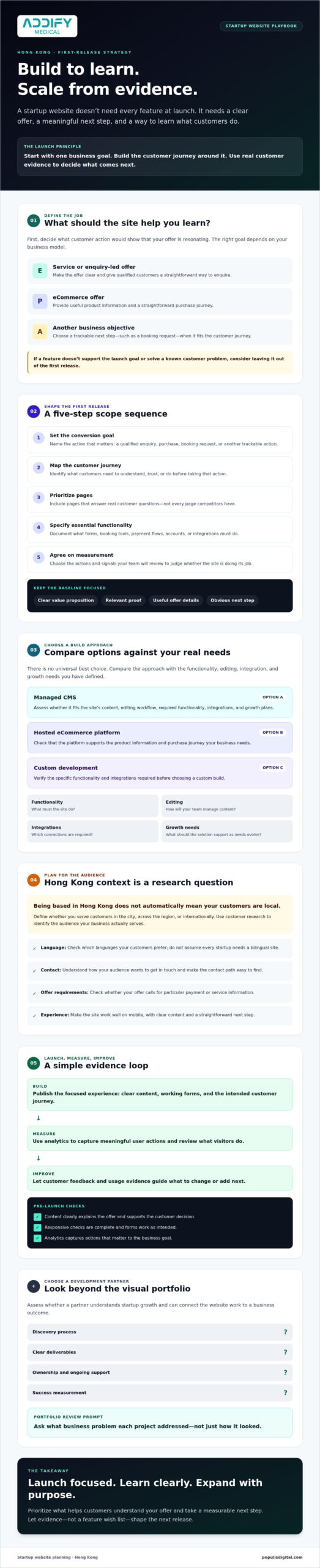
A clear scope turns a website brief into a decision-making tool. Don’t start by collecting features. Start by defining the action that matters, then build only what helps customers take it and your team learn from the response.
Use this sequence to shape the first release:
- Set the conversion goal. Decide whether the priority is a qualified enquiry, a purchase, a booking request or another trackable action.
- Map the user journey. Identify what customers need to understand, trust or do before taking that action.
- Prioritize pages. Include the pages that answer real customer questions, not every page competitors have.
- Specify functionality. Document what forms, booking tools, payment flows, accounts or integrations must do. Verify the requirements before selecting a solution.
- Agree on measurement. Choose the actions and signals your team will review to judge whether the site is doing its job.
Keep the baseline focused: a clear value proposition, relevant proof, useful product or service details and an obvious next step. The exact mix depends on your offer. An online store may need a purchase journey; a service startup may need a well-designed enquiry form. eLearning, booking and custom functionality belong in the scope only when the business model and customer journey call for them.
Which pages and functions belong in the first release?
Build the structure around customer questions. What is being offered? Why should a buyer trust it? What should they do next? A competitor’s sitemap may offer inspiration, but it doesn’t show that your startup needs the same pages. Keep only the content and functions required to explain the offer, build confidence and complete the intended action.
How can founders keep scope under control?
Classify every request as launch-critical, useful later or not yet supported by customer evidence. Define what the first release should help you learn, such as whether visitors understand the proposition or complete the enquiry journey. Then set change control: document new requests, assess them against the goal and agree on their impact on scope before adding them.
Agree in writing who owns the copy, images and other content, who reviews each deliverable, and who gives final approval. Set launch acceptance criteria too, such as which pages and functions must be checked and which analytics events need to register. Founders exploring local support can review Hong Kong government’s startup resources for relevant startup information.
With the brief grounded in business priorities, you can discuss web design and conversion rate optimization in the context of your growth plan.
Custom development or a CMS: how Hong Kong startups should compare options
There’s no universal winner. The right choice depends on validated requirements, who will run the site and how much change you expect. Compare each option against the work it needs to do, not just its label or initial build effort. A custom build isn’t automatically better, and a template-based option isn’t automatically less costly to operate if it brings ongoing limitations or workarounds.
| Option | Potential fit | Questions to verify |
|---|---|---|
| Managed CMS | A content-led site where the team needs to publish or update pages without developer involvement. | Can it support required editing, integrations and future changes? Who handles updates and support? |
| Hosted eCommerce platform | A conventional online store where selling products is the core website function. | Does it fit the required customer journey, payment flow and integrations? What can the team manage directly? |
| Custom development | A validated workflow or integration that suitable existing options can’t meet. | What dependencies, ownership responsibilities and ongoing expertise will the build require? |
These are starting points, not promises about any specific vendor’s capabilities. Confirm feature fit against your actual requirements, and clarify who owns site content, accounts and assets. Compare ongoing support and the effort needed to make changes, not just the first release. If the startup plans to sell online, include the customer’s full shopping journey in the evaluation and explore suitable eCommerce web design in Hong Kong options.
When is a CMS or hosted platform a sensible starting point?
A CMS may suit teams that need to maintain pages and publish content themselves. A hosted eCommerce platform may be worth assessing when the core requirement is a conventional online store. In either case, check the required functionality and integrations before committing. Ask who will manage content, updates and support after launch, and what happens when the business needs to change its site.
When might custom website development be justified?
Consider custom work when customer evidence points to a workflow or integration that suitable existing options can’t support. Weigh that need against your team’s capacity to maintain and improve the site over time. Ask shortlisted agencies to explain trade-offs, dependencies, ownership and the likely implications of future changes in writing. Technology startups exploring local ecosystem support can visit Hong Kong Science & Technology Parks Corporation (HKSTP) to learn about its programmes and support.
How to build, launch and measure a startup website in Hong Kong
A strong launch is a process, not a handover date. Each stage should protect the business goal: confirm what customers need, approve clear content and design, build the agreed journeys, test them, then review performance after launch. Agree on responsibilities and sign-off points early so decisions don’t stall and key details don’t get missed.
Before development is considered ready, check the essentials:
- Responsive experience: Review key paths on mobile and desktop, including navigation and page readability.
- Offer clarity: Confirm each page reflects the approved offer, with clear calls to action and accurate contact details.
- Working journeys: Submit forms yourself, and test checkout or booking flows if the site uses them.
- Measurement: Verify that analytics and conversion events record the intended actions using the selected tools and configuration.
Set up measurement before launch, not after the first campaign sends visitors to the site. Define the primary outcome, such as qualified enquiries or completed transactions, then select events that show whether visitors are moving through the journey. Visits can provide context, but they aren’t proof of business value on their own.
What should a startup test before the website goes live?
Walk through the site as a prospective customer. Can you understand the offer, find the relevant details and take the next step without confusion? Check the main journeys on mobile and desktop, test forms and any checkout or booking process, and confirm that the content, calls to action and contact information match the approved business offer. Then verify that the analytics setup captures the conversion events you agreed to track.
Check search visibility foundations as part of the build, including whether important pages can be found and understood by search engines. A detailed SEO strategy is a separate workstream. The launch check is about avoiding preventable gaps, not promising rankings.
What should founders measure after launch?
Review qualified enquiries or completed transactions against the site’s goal. Look for drop-off in the key journey, then combine that evidence with customer feedback to find friction. If visitors reach a form but don’t complete it, investigate the form and the expectations set by the page before deciding what to change.
Prioritize improvements based on evidence and likely business impact. Don’t trigger a redesign because of one isolated opinion. If the website needs a stronger follow-up journey after an enquiry or purchase, connect it with a considered marketing funnel rather than treating the site as a standalone asset.
To connect your website’s launch and measurement plan to customer acquisition, explore website design and marketing funnel support.
Choose a Hong Kong startup website partner that can support growth
The right partner doesn’t just make the site look polished. They connect business goals to a clear scope, a usable customer journey and a measurement plan. Judge fit by how an agency thinks, communicates and defines success, not by a portfolio’s visual style alone.
What should a startup ask a web development agency?
Ask how the agency turns your business goals and customer research into a documented scope. Clarify who supplies and approves content, who administers the platform, what handover includes and what ongoing support covers. Before signing, request a written explanation of assumptions, dependencies, exclusions and how success will be measured. Clear answers reveal whether the proposal fits your needs or relies on unresolved decisions.
Review relevant projects with a business lens. Ask what problem each site was built to solve, which customer journey it supports and how the team evaluated its performance. A visually impressive project may not demonstrate that the partner can translate your startup’s acquisition or conversion priorities into a practical website plan.
How can a website connect to the startup’s growth system?
Your site should work with the channels bringing customers to it. Landing pages can align with SEO and paid campaigns so visitors encounter a consistent offer and a relevant next step. As customer data accumulates, conversion rate optimization (CRO) and marketing funnel planning can help identify where to refine the journey or what follow-up to test. These are connected capabilities, not a promise of specific results.
Populis Digital is a Hong Kong-based agency offering web design, SEO, Google Ads management, Facebook and Instagram Ads management, CRO and marketing funnel creation. Its work with SMEs spans healthcare, fitness, education, retail and real estate. Use your own requirements to assess whether a provider’s services and approach fit your growth priorities.
Ready to discuss a startup website plan? Share your business goal, intended customer journey and launch priorities with Populis Digital. The recommended scope should depend on your specific requirements, not a one-size-fits-all package.
Turn Your First Website Into a Growth Asset
The strongest startup website isn’t the one with the longest feature list. It’s the one built around a clear business goal, sized to meet real customer needs and ready to generate insight after launch. That’s the foundation of effective website development for startups Hong Kong.
Keep the first release focused: choose the pages and functions that support a meaningful customer action, then select a platform based on confirmed requirements and your team’s capacity to manage it. Before launch, check the core user journeys and tracking. After launch, use customer feedback and performance data to decide what deserves improvement next.
Populis Digital is a Hong Kong-based agency offering web design alongside SEO, paid advertising, conversion rate optimization and marketing funnel creation. Its SME experience spans healthcare, fitness, education, retail and real estate. The right scope depends on your business, audience and growth priorities.
Plan a growth-focused startup website with Populis Digital and discuss an approach shaped around your requirements. Start with a clear goal, build with purpose and give your next growth decision a stronger foundation.
Frequently Asked Questions
How much does website development for a startup in Hong Kong cost?
There’s no single price for website development for startups Hong Kong because the scope drives the investment. A focused company profile site differs from an eCommerce store or a website with custom integrations. Define required pages, functionality, content responsibilities, platform and support needs before comparing proposals. Ask each provider to separate included work from assumptions and exclusions so you can compare like for like instead of choosing on headline price alone.
How long does it take to build a startup website?
Build time depends on the project scope and how quickly decisions, content and approvals are ready. A focused site with agreed requirements may involve fewer workstreams than a custom build or an online store with integrations, but no timeline should be assumed without reviewing the brief. Ask for the stages, dependencies and approval points in writing. Confirm what could affect delivery, including late content, added features or changes to the agreed scope.
Does a startup need a custom-built website?
No. A startup should choose custom development only when confirmed requirements, such as a specific workflow or integration, can’t be met by a suitable existing option. A CMS can suit teams that need to update content themselves, while a hosted eCommerce platform may fit a conventional online store. Compare functionality, editing, ownership, integrations and ongoing support. The best option is the one that meets current needs without creating unnecessary maintenance complexity.
What pages should a startup website include?
Include the pages needed to explain the offer, establish trust and help visitors take the intended next step. Depending on the business, that may mean a homepage, product or service details, relevant proof and a clear contact or purchase path. Map pages to customer questions rather than copying a competitor’s structure. Add booking, account or other functionality only when it supports a validated customer journey or a specific business requirement.
Should a Hong Kong startup website be bilingual?
Not automatically. Choose languages based on research into your intended customers, not simply because the business is based in Hong Kong. If your target buyers use both English and Traditional Chinese, a bilingual experience may be appropriate. If your audience uses one language, start there and validate demand before expanding. Consider whether both versions can be kept accurate and up to date, and test language preferences with actual customers.
How can a startup website generate leads after launch?
Give visitors a clear next step, such as a relevant enquiry form, and make sure the page explains what they’re asking about. Connect landing pages to the message in SEO or paid campaigns, then track qualified enquiries rather than visits alone. Review where users leave the journey and gather customer feedback before making changes. A marketing funnel can help plan follow-up after an enquiry, while conversion rate optimization can guide evidence-based improvements.
What should I ask a website development agency before hiring it?
Ask how the agency turns business goals and customer research into a documented scope, what deliverables are included and what the proposal excludes. Clarify who supplies and approves content, who owns and administers the site, and what handover and ongoing support involve. Ask how success will be measured and what assumptions or dependencies could affect the work. Review relevant projects by asking what business problem each solved, not just how the sites look.